

In the high-stakes world of sales, everyone wants to know the secret sauce. Why does one rep consistently crush quota while another struggles to build pipeline? For sales leaders and HR partners, the answer usually lies in the data. But with CRM dashboards throwing endless numbers at you, it’s easy to get lost in “vanity metrics”—data points that look good on paper but don’t actually move the needle.
To build a high-performing team, you need to look beyond simple activity tracking. You need a clear view of sales rep productivity metrics that tell you not just how busy your team is, but how effective they are.
Whether you are trying to decrease ramp time for new hires or optimize the performance of veterans, understanding the right metrics is the first step toward orchestration—getting the right people, tools, and resources aligned to drive revenue.
The Three Pillars of Sales Performance Metrics

To get a holistic view of performance, it helps to break down your data into three distinct categories: Quantity, Quality, and Efficiency.
1. Quantity Metrics (Activity Volume)
These are the foundational “hustle” metrics. While high activity doesn’t guarantee high revenue, you can’t close deals that don’t exist.
- Number of calls, meetings, and demos: This is the baseline pulse of your sales floor (or remote team).
- New opportunities created: Are your reps opening doors? This tracks the raw potential entering the funnel.
- Email and prospecting activity: In a digital-first world, tracking outreach volume across channels is essential.
If you are bringing on new reps, setting expectations for these volume metrics is a critical part of sales onboarding.
2. Quality Metrics (Impact & Conversion)
This is where sales rep effectiveness metrics come into play. It’s not just about making 50 calls; it’s about what happens during those calls.
- Win rate: The percentage of opportunities that turn into closed deals. A low win rate with high activity suggests a training or targeting gap.
- Lead qualification rate: How effectively is the rep vetting prospects? High qualification rates usually lead to smoother sales cycles.
- Forecast accuracy: Can the rep predict their own success? reliable forecasting is a sign of a mature, disciplined salesperson.
- CSAT and Net Promoter Score (NPS): Sales isn’t just about the signature; it’s about the customer experience. High scores here predict long-term retention.
3. Efficiency Metrics (Output per Effort)
Efficiency is the true measure of sales productivity metrics. It answers the question: How much revenue are we generating for every hour of effort?
- Sales cycle length: The average time from first contact to signed contract. Shorter cycles free up reps to chase more deals.
- Pipeline velocity: A powerful metric that combines deal value, win rate, and cycle length to show how fast revenue moves through the system.
- Revenue per rep: The ultimate bottom-line metric for individual contribution.
- Quota attainment: The percentage of reps hitting their goals. If only 20% of your team is hitting quota, the problem might be the target, not the talent.
Struggling to standardize these metrics? Use our sales onboarding plan template and checklist to build a consistent framework.
Retention and Lifetime Metrics That Complete the Picture
Sales productivity doesn’t stop when the contract is signed. In modern SaaS and enterprise environments, the initial sale is just the beginning of the relationship. To truly measure sales effectiveness, you must look at the long-term health of the accounts your reps bring in.
- Customer Churn Rate: If a rep closes deals that churn in 90 days, were they productive? Likely not.
- Net Revenue Retention (NRR): This measures income retained from existing customers, including upgrades and cross-sells.
- Customer Lifetime Value (CLV): This helps you understand the long-term ROI of your sales team’s acquisition efforts.
A Smarter Framework: Input vs. Output Metrics
Another way to categorize sales productivity metrics is by distinguishing between what you can control (inputs) and the results (outputs).
Input Metrics: What Your Team Puts In
These are leading indicators. You can coach a rep to change these behaviors tomorrow.
- Time spent selling: Are they bogged down in admin work, or actually facing customers?
- Prospecting effort: The volume of customized emails or LinkedIn touches.
- Learning and development: Completion of training modules and role-play exercises.
Output Metrics: What Comes Out
These are lagging indicators. They tell you what happened in the past.
- Revenue: The total bookings number.
- Deals closed: The number of signed contracts.
- Market reach: The expansion into new territories or verticals.
Balancing Both for a True Productivity View
If you only manage to outputs (revenue), you’ll miss the warning signs of a dry pipeline. If you only manage to inputs (calls), you might encourage “busy work” that doesn’t convert. The magic happens when you analyze the relationship between the two.
How to Make These Metrics Actionable
Data without action is just noise. Here is how to turn these numbers into a strategy that accelerates performance.
Focus on Leading vs. Lagging Indicators
Lagging indicators (like last quarter’s revenue) confirm success, but leading indicators (like this week’s demos booked) predict it. Shift your coaching focus to leading indicators to catch performance dips before they impact the bottom line.
Use Pipeline Analysis for Coaching
Don’t just ask “what’s closing?” Ask “where are deals getting stuck?” If a rep has high activity but low conversion, they might need help with their pitch. If they have high conversion but low volume, they need help with time management or prospecting.
For a deeper dive into measuring new hire progress specifically, check out our guide on onboarding metrics.
Benchmarking and Goal-Setting
Set S.M.A.R.T. goals based on team averages. If the average sales cycle is 4 months, challenge your team to reduce it to 3.5 through better qualification.
How to Avoid Common Mistakes When Measuring Sales Productivity

- Don’t Confuse Activity with Effectiveness: Just because a rep sends 100 emails doesn’t mean they are effective. Look at response rates alongside volume.
- Watch for Data Inconsistency: Ensure every rep defines “stage 2 opportunity” the exact same way in the CRM.
- Avoid Tracking Metrics Without Accountability: If you track it, review it. If a metric doesn’t appear in 1:1s or team reviews, reps will ignore it.
- Reduce Subjectivity: “I feel like they are working hard” isn’t a metric. Rely on the data.
Where Enboarder Helps: Enabling Productivity from Day One
The biggest killer of sales productivity is often the “ramp time”—the months it takes for a new rep to become fully productive. Traditional onboarding often overwhelms new hires with static documents and disjointed checklists, leading to slower time-to-productivity and higher attrition.
This is where Enboarder changes the game. As an intelligent journey platform, Enboarder acts as a “system of action” that sits above your existing HR and sales stacks.
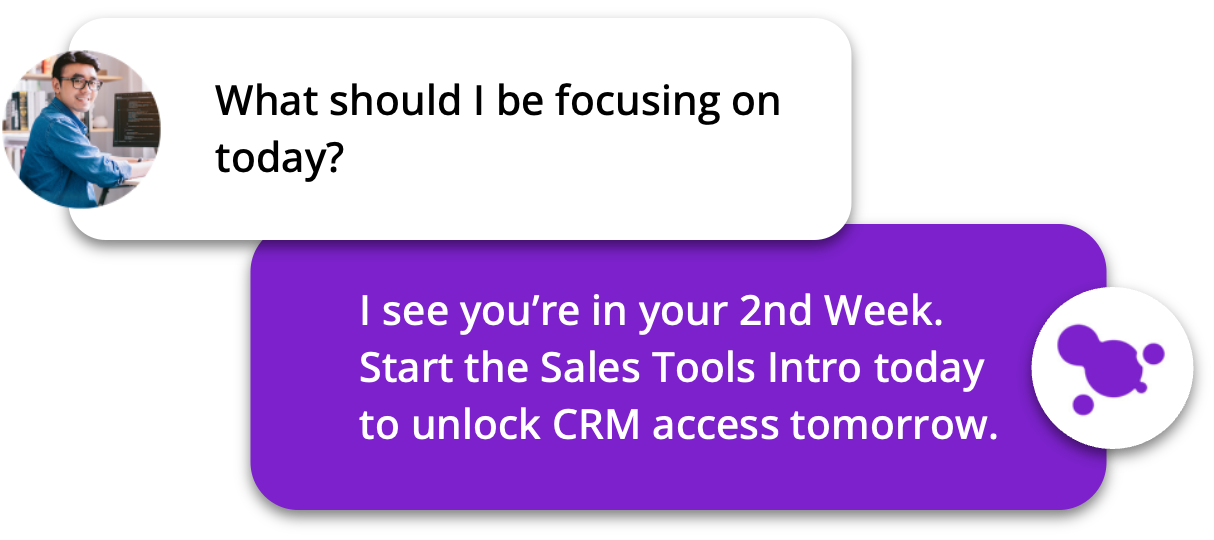
- Reduce Ramp Time with AI-Driven Journeys: Enboarder’s AI Agents can auto-generate role-specific 30-60-90 day plans that structure exactly how new reps learn and perform. Instead of a generic welcome, they get a sequenced path to productivity.
- Automate Enablement in the Flow of Work: Forget nagging reps to read a PDF. Enboarder orchestrates tasks, learning modules, and reminders directly in the tools they use daily (like Slack, Teams, or email).
- Enable Managers with Real-Time Coaching: Managers are busy. Enboarder’s Employee Journey Assistant provides managers with timely prompts and best practices exactly when they need to intervene, ensuring they are coaching based on real-time progress.
The impact of this orchestration is measurable. For example, a large telecommunications provider improved sales new hire productivity by 20% simply by implementing effective functional onboarding that connected new hires to the right people and content at the right time.
By focusing on the metrics that matter and using a platform that orchestrates action, you can move beyond simple tracking and start driving genuine sales rep effectiveness.
Ready to orchestrate a better sales ramp-up? Explore our employee onboarding platform to see how we help teams reach their full potential.
