

Let’s be real: hiring a superstar sales rep is only half the battle. The true win comes when you get that new hire ramped up, hitting quota, and generating revenue faster than your competitors can refresh their coffee.
Unfortunately, many sales organizations treat onboarding like a forgotten attic—a dumping ground for paperwork and maybe a CRM login if they’re lucky. This broken process costs organizations dearly, leading to slow ramp times, early turnover (which 61% of HR leaders cite as a concern), and delayed revenue.
We believe onboarding should be an experience, not an obstacle course.
This template and checklist is your blueprint for creating a consistent, scalable, and highly effective sales onboarding program. We’re focusing on task completion here, giving you the essentials without the fluff. Whether you need to increase quota attainment by 20%—like one major telecom company did using a structured approach—or just reduce ramp time, this guide is your go-to.
Sales Onboarding Checklist: Everything You Need for a Successful Launch
Effective sales onboarding doesn’t just happen; it requires strategic measurement. Before you dive in, consider how you’ll measure the success of this program—from analyzing pipeline contributions to calculating your overall onboarding ROI and establishing clear employee onboarding metrics.
Let’s break down the journey.
1. Preboarding (Offer Acceptance to Day 1)

Preboarding is the critical phase where excitement meets administration. The goal here is to handle logistics, build anticipation, and reduce Day 1 anxiety. If they’re spending Day 1 filling out forms, you’re already behind.
| Key Tasks | Why It Matters |
|---|---|
| Send a warm welcome message: This should come immediately upon offer acceptance, ideally from the manager or team lead. Make it personalized, not automated. | Sets a positive, engaging tone and reinforces their decision to join your team. |
| Share the onboarding timeline and key contacts: Provide a high-level roadmap so the new hire knows what the first 30/60/90 days will look like and who to reach out to with initial questions. | Reduces ambiguity and provides immediate psychological safety. |
| Complete administrative paperwork and provision technology/tools: Get HR documents signed digitally and ship laptops, phones, and software access (CRM, communication tools) well ahead of time. | Ensures Day 1 is dedicated to connection and culture, not clicking through forms. |
| Introduce the sales manager and assign an onboarding buddy: Connecting them early fosters relationships. The buddy should be a high-performing non-managerial peer. | Provides a friendly, non-hierarchical source of information and integration. |
| Brief overview of product, role goals, and organizational structure: Give them some homework! This doesn’t need to be intense, just enough context so they aren’t starting from zero. | Enables productive conversations on Day 1. |
2. Day 1 – Connection & Confidence

Day 1 is all about reaffirming the culture and providing context. It should be memorable, positive, and focused on making the rep feel valued and welcomed.
| Key Tasks | Why It Matters |
|---|---|
| Personalized welcome from manager or team: Go beyond a quick “hello.” Maybe a catered team lunch or a dedicated welcome slide during a team meeting. | Makes the new hire feel seen and appreciated immediately. |
| Orientation to mission, culture, and the onboarding journey: This is where you explain the ‘why’ behind your work and introduce your unique Enboarder-style onboarding journey. | Provides purpose and context for their hard work. |
| Overview of sales team structure and support system: Clarify reporting lines and where to find key internal resources (SDR team, Sales Engineers, Marketing collateral). | Defines their place in the revenue machine. |
| Light introduction to product and customer base: Focus on the value proposition and the customer pain points, not technical deep dives. | Helps them understand who they will be speaking to and what they will be solving. |
| Clarify expectations for the first week: Give them achievable, measurable goals for Week 1 (e.g., meeting 5 key people, completing 3 specific training modules). | Establishes immediate focus and accountability. |
3. Week 1 – Foundations and Familiarization
This week is dedicated to absorbing foundational knowledge needed to communicate intelligently with customers and navigate internal systems.
| Key Tasks | Why It Matters |
|---|---|
| Complete product and market training modules: Deep dive into product features, competitive landscape, and key differentiators. This should be self-paced but structured. | Builds necessary product fluency. |
| Introduction to sales methodology: Train them on how your team sells—whether that’s qualification frameworks (BANT, MEDDIC) or specific approaches to negotiation. | Ensures consistent application of your high-performance sales strategy. |
| CRM and tools walkthrough: Hands-on training for the systems they will live in (CRM, sales engagement platforms). Focus on logging activities and pipeline hygiene. | Good data hygiene starts on Day 5, not Day 50. |
| Shadow 2–3 live calls or demos: Observe experienced reps in action, noting pacing, discovery questions, and objection handling. | Provides real-world context for the training modules. |
| End-of-week check-in with the manager: A low-pressure conversation to review progress, troubleshoot immediate issues, and reiterate support. | Crucial for course correction and maintaining momentum. |
4. Weeks 2–4 – Skill Application & Early Wins
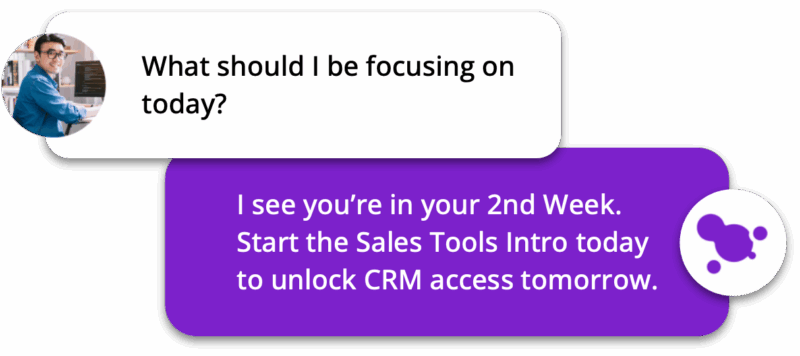
The transition from learning to doing. The goal here is low-stakes practice and building basic pipeline confidence.
| Key Tasks | Why It Matters |
|---|---|
| Begin prospecting with scripts/templates: Start outbound activities using approved, tested materials. The focus is volume and adherence to process. | Converts abstract learning into practical action. |
| Run mock sales calls with manager feedback: Use scenarios to simulate real customer interactions. Feedback should be immediate, specific, and positive. | Builds confidence before facing actual prospects. |
| Conduct low-stakes outreach and pipeline building: Focus on easy-to-reach or less critical accounts to build initial muscle memory without high pressure. | Generates early activity metrics and minimizes risk to major accounts. |
| Continue shadowing + dedicated coaching sessions: Pair shadowing with 1:1 coaching focused on specific skill gaps identified in mock calls. | Targeted development based on performance data. |
| Set 30-day review goals with manager: Formalizing expectations for their first month. This fits perfectly into a well-structured 30-60-90 day plan. | Provides clear benchmarks for success. |
5. Month 2 – Independent Selling & Coaching
By now, the rep should have the foundational knowledge and the system access needed to function autonomously. Month 2 focuses on mastering the sales cycle.
| Key Tasks | Why It Matters |
|---|---|
| Own a sales cycle from outreach to follow-up: The rep takes full ownership of leads or assigned accounts, utilizing all their training. | Proves capability and starts generating measurable pipeline contributions. |
| Close small to mid-size deals with manager support: Target achievable revenue goals. Manager support acts as a safety net. | The thrill of the first few wins is invaluable for morale and retention. |
| Attend advanced objection-handling and negotiation workshops: Move beyond basic script adherence to nuanced, strategic communication. | Increases conversion rates in complex deals. |
| Start participating in team huddles and pipeline reviews: They should now be able to contribute meaningfully to sales discussions. | Integrates them fully into the team’s strategic operations. |
| Peer mentor check-in: The onboarding buddy or a peer mentor can provide insights and practical tips that managers sometimes overlook. | Fosters continued cultural connection. |
6. Month 3 – Performance, Optimization & Scaling

Welcome to the finish line of the core onboarding period! Month 3 is about achieving consistency and optimizing personal performance to set the stage for long-term growth.
| Key Tasks | Why It Matters |
|---|---|
| Hit or exceed quota benchmarks: This is the primary success metric for the 90-day period. | Confirms they are fully ramped and revenue-producing. |
| Personalize outreach, refine pitch: They move beyond standard templates, customizing their approach based on market feedback and personal style. | Increases effectiveness and scalability. |
| Analyze and report on personal metrics: Review conversion rates, activity volume, and average deal size. Reps must be accountable for their data. | Encourages self-management and optimization. |
| Present learnings to the team or mentor a new hire: Sharing their journey helps solidify their learning and offers valuable peer insight. | Positions them as an internal expert and team leader. |
| Complete 90-day review with manager: A formal review covering performance, cultural fit, and goal setting for the next phase. (This is especially important given the key findings in our HR leader survey report on winning the first 90 days!) | Official confirmation of success and definition of future career paths. |
How Enboarder Simplifies and Automates Sales Onboarding

A structured checklist is vital, but managing it manually across different roles, territories, and managers can quickly become chaotic. That’s where an experience layer steps in—to handle the heavy lifting so your managers can focus on coaching, not coordination.
When you use an intelligent platform, you can transform your sales onboarding by integrating systems and automating the entire process:
- Automate Task Delivery, Reminders, and Feedback Loops: Say goodbye to chasing signatures or confirming tool access. The platform handles the administrative bottlenecks, ensuring tasks are delivered to the right person (rep, manager, IT) at the right time. This accelerates your employee onboarding automation.
- Personalize the Journey: A rep in North America selling enterprise software requires a different track than a rep in Europe focusing on mid-market SaaS. Personalize content and milestones based on role, location, or experience level.
- Coach Managers with Nudges and Support: Managers are the biggest variable in onboarding success. Our platform provides managers with automated nudges (e.g., “Time to schedule the Week 1 check-in!”) and resources, ensuring they provide timely and effective coaching.
- Track Onboarding Progress and Performance: Monitor completion rates, eNPS, and correlate early onboarding metrics with actual quota attainment. You can track the progression and see how effective your training is.
- Eliminate Administrative Bottlenecks: By automating logistics, you reduce the non-selling time for both the rep and the manager, leading to a much faster return on investment (ROI). This is why effective employee onboarding software is critical.
