

TD;LR
Sales onboarding is the crucial bridge between hiring a great rep and seeing them hit quota fast. It goes beyond simple orientation, offering job-specific training and hyper-personalized experiences that drive productivity and significantly boost your bottom line. A well-structured sales onboarding process decreases ramp time, boosts morale, and ensures long-term retention. By leveraging automation and no-code software, companies can personalize these journeys at scale, enabling managers to deliver targeted coaching and support that gets reps selling faster and smarter.
What Is Sales Onboarding and Why It Matters
Sales onboarding is the process of introducing new sales reps to your organization and giving them the tools and resources they need to thrive. As with any onboarding process, we recommend you structure sales onboarding around a hyper personalized new hire experience and follow the 5 C model: covering compliance, clarification, culture, competence, and connection.
Sales onboarding requires a different approach from general onboarding—it’s about functional onboarding. While sales rep orientation will last a couple of hours or days and walk them through your company policies and benefits, sales onboarding is a long-term process that begins the moment that offer is signed and ideally continues throughout their first year on the job.
Getting this process wrong carries serious business risks, including high attrition, turnover, low performance, and long ramp times on your sales teams. In fact, survey data shows that 35% of new hires with a negative onboarding experience found it difficult to perform their jobs successfully, and another 33% immediately started looking for a new job. An effective process drives productivity, boosts morale, and ensures a well-structured onboarding educates reps on buyer pain points, products, and your company’s sales process. Get that right, and you can decrease ramp time and get to closing deals even more quickly.
Key Phases of an Effective Sales Onboarding Journey
Keep in mind the difference between onboarding and orientation. Sales rep orientation will last a couple of hours or days and walk them through your company policies and benefits. Sales onboarding is a long-term process that begins the moment that offer is signed and ideally continues throughout their first year on the job.
Let’s walk through some of the key phases to include in your sales onboarding process.
Preboarding (Offer to Day One)
The first step to decreasing ramp time for your new rep is to maximize the time between the offer being signed and day one. You want to start building a crucial connection between your sales rep and their hiring manager immediately. This phase should include getting as much paperwork as you can out of the way and setting up internal tools and systems.
Preboarding should include sending a welcome package with all the tools they need to hit the ground running, as well as a gift to reassure them they made the right choice. Share information about your company, role expectations, and introductions to their team and the company culture, along with a high-level overview of their first day, week, and month.
What will really make your company stand out is personalization: ask your new sales rep to share a little bit about themselves, like their favorite 3 p.m. munchie or favorite cuisine, and even a quick video introducing themselves to the team (Enboarder’s Video on the Go makes this super easy).

Day One Onboarding
For most companies, day one is all about orientation – showing your new hire around the office, introducing them to their team and co-workers, and checking off all the compliance bits. You want to make your new sales rep feel welcomed and confident in their decision to join your company.
If they’re starting at your office, surprise them with their 3 p.m. munchie on their desk and take them out for a welcome lunch at a restaurant that serves their favorite cuisine. These personalized touches ensure your sales rep starts on the right foot from the very start.
Product, Market & Sales Process Training
You want your sales rep to know your product inside and out, and onboarding should give them a solid grounding of product knowledge. Use creative training methods like role-swap exercises and gamification with interactive quizzes.
Ensure training covers the competitive landscape, your defined sales methodology (the series of steps your sales team uses to sell to prospects), and proper CRM usage. Crucially, your team must be trained on objection handling and qualification techniques.
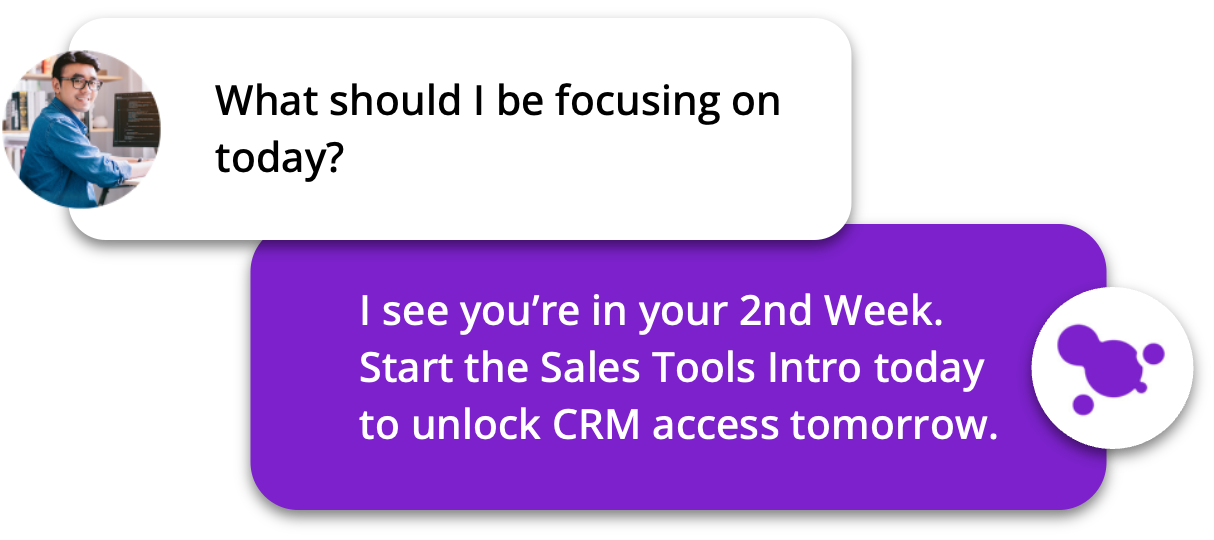
Sales Process Training
A significant portion of your sales onboarding should cover your sales methodology – the series of steps your sales team uses to sell to prospects. This will teach them how to nurture leads from potential customers to converted buyers.
Shadowing, Coaching, and Peer Learning
Especially since 71% of sales reps work in a hybrid environment, clear communication and dedicated coaching are critical. You’ll want to set them up for success by assigning peer mentors and connecting them with your most seasoned team members.
This phase involves observing experienced reps on sales calls and demos and setting up scheduled feedback and coaching loops to continually refine their process.
Ongoing Development with a 30-60-90 Day Plan
A helpful way to think about ongoing development for your sales reps is to craft a 30-60-90 day plan with clear milestones for learning, implementation, and refinement. This framework ensures ownership and alignment across the rep, the manager, and L&D teams.
• 30 Days: Focus on learning systems, shadowing experienced reps, and prospect research.
• 60 Days: The goal shifts to running calls/demos, actively implementing techniques, and closing small deals.
• 90 Days: The rep should now own their pipeline, move on to closing larger deals, and start mentoring others.
Sales Onboarding Metrics – How to Measure Success
How do you know if your sales onboarding process is actually working? Start measuring! Key metrics to track success include:
• Time to First Sale: How quickly are new hires closing their first deal?.
• Ramp Time to Quota: How long does it take for a new rep to meet their sales quota consistently?.
• Quota Attainment: Are reps successfully hitting their targets?.
• New Hire Retention: Are your new hires staying for the long term?.
• Training Completion Rates: Are reps completing all required onboarding training within the expected timeframe?.
• eNPS and Satisfaction Scores: How do new hires rate their onboarding experience in feedback surveys?.
Common Pitfalls in Sales Onboarding (And How to Avoid Them)
Overloading New Hires with Too Much Information
We’re all inundated with notifications all day long – the average American smartphone user receives 45 notifications per day. So if you frontload your sales onboarding with too much information, it’s bound to get lost in the noise. Pace out your communications and training so you get the desired impact.
Lack of Follow-Up After Initial Onboarding
Ideally, onboarding should last well into your sales rep’s first year on the job. You’ll want to integrate surveys and gather feedback on what’s working well and anything that might be missing in their onboarding. You’d be amazed at what you learn just by asking!
Not Leveraging Onboarding Software
Onboarding software like Enboarder can automate the whole sales onboarding process – delivering immediate ROI and saving you precious time so you can focus on more strategic work. In fact, Zapier was able to save 86 work weeks by using Enboarder!
Ignoring the Role of Culture in Sales Team Success
How your new sales rep feels about their role and your company has a direct impact on their performance. If they don’t feel like they belong and morale is low, that will inevitably influence their interactions with prospects. Use creative onboarding ideas, team-building activities (like Enboarder’s Connection Networking Game below), and buddy systems to really bring your culture to life during sales onboarding.
Failing to Update Onboarding Materials and Processes
Your sales onboarding process is only as effective as its ability to evolve with your company, your product, and broader market trends. Whether you need to educate sales reps on new features, pricing changes, or sales process updates, you want to make sure your sales onboarding can easily be adjusted on the fly (thankfully, Enboarder’s no code builder makes this super simple).
Lack of Personalized Onboarding
If you want to improve employee engagement and productivity, your entire sales onboarding process should be designed with your sales rep’s success in mind. Onboarding is not about what you need from your sales rep, but what information, tools, and people will get them up to speed and selling as soon as possible. For example, a seasoned rep should have a slightly different onboarding than a rep early in their career or just out of college.
How to Optimize Sales Onboarding with Enboarder
Successful sales onboarding is about much more than checking off a list of training sessions. It’s about creating a structured yet flexible process that connects your new sales reps to your mission and the tools and information they need. Onboarding software like Enboarder is the key to scaling personalization and saving precious time.
We enable you to deliver exceptional onboarding by:
• Automating communications and tasks: Automate preboarding, training delivery, surveys, and reminders so you can focus on more strategic work. In fact, Zapier was able to save 86 work weeks by using Enboarder!
• Personalization at scale: Use our no-code tools to easily adjust your onboarding on the fly. This ensures your entire sales onboarding process is designed with the rep’s success in mind, recognizing that a seasoned rep should have a slightly different onboarding than a rep early in their career.
• Manager enablement: Provide managers with structured nudges and check-ins to ensure they are actively involved in the coaching and feedback loops.
Ready to see how Enboarder can reduce your ramp time and get your sales reps to sell faster? See how we helped a Fortune 500 telecom provider implement a personalized sales onboarding journey. Book your demo now!
