

Sixty percent of organisations are already using or testing AI onboarding tools, according to the IDC TechBrief: AI-Empowered New Hire Onboarding. Another 25% plan to invest in the next 12 to 18 months. The direction of travel is clear.
But adoption isn’t the same as readiness. And investing before your foundations are solid doesn’t accelerate your onboarding outcomes — it amplifies every gap you already have.
That’s why we built the AI Onboarding Readiness Infographic: a practical framework for HR and TA leaders who want to make a confident, informed investment decision. Whether you’re evaluating solutions now or building the business case with your CHRO or CFO, this framework gives you the right questions to ask — of your organisation, and of every vendor you speak to.
If you’re starting from scratch on what AI onboarding actually means and whether your organisation is behind the curve, our post Is Your Organisation Ready for AI-Enabled Onboarding? The Data Says Most Aren’t is a useful starting point. Come back here when you’re ready to pressure-test your readiness before you invest.
The Three Dimensions of AI Onboarding Readiness
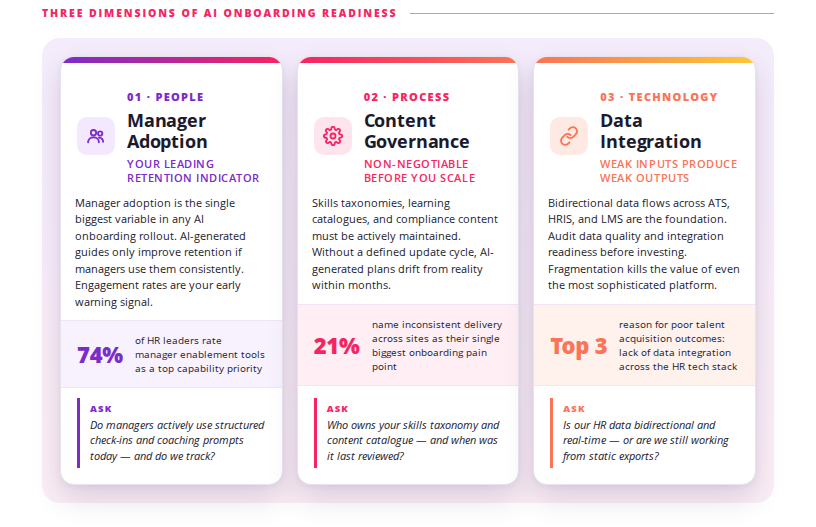
Research consistently points to three areas that determine whether an AI onboarding investment delivers lasting value — or stalls at implementation. Miss any one of them and even the most sophisticated platform will underperform.
01. People: Manager Adoption
Manager adoption is the single biggest variable in any AI onboarding rollout — and the one most organisations underestimate.
AI-generated guides, coaching prompts, and personalised check-ins only improve retention when managers use them consistently. If engagement drops, the most critical human touchpoint in onboarding disappears with it. According to research commissioned by Enboarder (February 2026), 74% of HR leaders rate manager enablement tools as a top capability priority for 2026 — yet most still treat manager training as a one-time event rather than an ongoing discipline.
Before you invest, ask: are your managers actively using structured check-ins and coaching prompts today? Do you track engagement rates as a leading indicator of new hire retention? If the honest answer is no, that’s your starting point — not the vendor selection process.
02. Process: Content Governance
Skills taxonomies, learning catalogues, and compliance content power everything downstream in an AI onboarding system. But they only work if someone owns them.
Without a defined update cycle, AI-generated onboarding plans drift from reality within months. New roles, revised policies, updated learning content — if your inputs are stale, your outputs will be too. According to Enboarder’s February 2026 research, 21% of HR leaders name inconsistent content delivery across sites and regions as their single biggest onboarding pain point.
The question isn’t whether your vendor’s content engine is sophisticated. It’s whether your organisation has the governance structure to keep it fed with accurate, current information. A practical approach to onboarding automation starts with mapping your cross-functional workflows and identifying exactly where content ownership breaks down before you automate anything.
Ask yourself: who owns your skills taxonomy and content catalogue right now — and when was it last reviewed?
03. Technology: Data Integration
Bidirectional integration across your ATS, HRIS, and LMS is the foundation everything else sits on. Weak inputs produce weak outputs, regardless of how advanced the platform is.
According to the IDC TechBrief: AI-Empowered New Hire Onboarding (#US54032026, March 2026), lack of data integration across the HR tech stack is among the top three reasons for poor talent acquisition outcomes. Data fragmentation doesn’t just slow AI down — it breaks it. This is why HR leaders building AI-powered blended workforces consistently identify the HR-IT integration layer as the first thing to get right, before any agentic automation can deliver value.
Audit your data quality and integration readiness before you evaluate vendors. Is your HR data bidirectional and real-time? Or are you still working from static exports and manual syncs?
Pre-Investment Readiness Snapshot
Before you start vendor conversations, run this self-assessment across all three dimensions. If you’re ticking boxes confidently, you’re ready to invest. If you’re not, you’ve just identified your implementation risks before they become expensive surprises.
People Readiness
- Manager adoption of current tools is measurable
- HR enablement is ongoing, not a one-time event
- Engagement rates are monitored as a retention signal
- Clear escalation paths exist for when AI should defer to a human
Process Readiness
- Skills taxonomy is owned, maintained, and current
- Content governance has a defined review cycle
- Cross-functional onboarding workflows are mapped
- Variation across regions, roles, and employment types is documented
Technology Readiness
- HR tech stack integrations are bidirectional
- Data quality and governance has been audited
- Compliance and security controls are native, not bolt-ons
- IT provisioning workflows are mapped and automated
If you’re working through this and want the full research behind each dimension, the IDC TechBrief covers the complete organisational readiness assessment framework. Download it here.
Questions to Ask Before You Invest
The infographic’s due diligence guide covers two types of questions: those you should direct inward at your own organisation, and those you should put to every vendor you evaluate. Use both sets. They’re designed to work together — what you uncover internally shapes exactly where to push vendors hardest.
If you’re at the stage of building a formal business case to take to leadership, our guide on how to build a business case for onboarding software walks through how to frame the ROI conversation with your CFO and align exec stakeholders before the vendor process begins.
Internal Readiness Questions
Outcomes and Measurement
- What specific business outcomes do we need this investment to address?
- How will we define and measure time to productivity?
- What does success look like at 90 days, 6 months, and 12 months?
Data and Integration
- Is our HR data quality sufficient to support AI-generated recommendations?
- Are our ATS, HRIS, and LMS systems integration-ready?
- Do we have bidirectional, real-time data flows — or are we still relying on static exports?
People and Governance
- How strong is manager adoption of our current onboarding tools and processes?
- Who owns our skills taxonomy and learning content — and how current is it?
- Do we have clear guidelines for acceptable AI use and human escalation paths?
Workforce Complexity
- How do we support remote, hybrid, and in-person employees consistently?
- What variation exists across regions, roles, and employment types?
Vendor Evaluation Questions
These questions are drawn from the IDC TechBrief’s vendor evaluation framework. Bring them into every discovery call — and pay close attention to how vendors respond when the questions get specific. Vague answers on data flows and AI transparency are a signal worth heeding.
Outcomes and ROI
- What metrics and dashboards are available to measure onboarding ROI?
- How do you define and track time to productivity?
- What implementation timeline and change management support do you provide?
Data and Integrations
- How does your solution ingest data from ATS, HRIS, and assessment platforms?
- Is the data flow bidirectional and real-time?
- What encryption standards, role-based access controls, and audit trail capabilities are native to the platform?
AI Transparency and Risk
- How are AI-generated recommendations explained to managers and new hires?
- How are early attrition risk signals surfaced — and to whom, on what cadence?
- How do you manage model updates and notify customers of algorithm changes?
Compliance and Scale
- What GDPR, CCPA, and regional compliance features are built in — not bolt-ons?
- How scalable is the solution across geographies, brands, and employee populations?

The Metrics That Matter
Once you’ve invested, you need to know what good looks like. The IDC TechBrief identifies two core measurement categories for AI-empowered onboarding — and together they give you a performance framework that keeps improving with every cohort. Understanding these metrics upfront also shapes what you demand from vendors during the evaluation process: if a platform can’t surface these numbers, it can’t prove its value.
For a deeper look at how AI is eliminating the experience gaps that make these metrics hard to move in the first place, AI-Native Onboarding: The End of Employee Experience Gaps is worth a read.
Efficiency
Track the reduction in manual effort across HR, IT, and hiring managers. Your leading indicators are:
- Reduction in HR, IT, and manager administrative time
- Automated task and IT provisioning completion rates
- Cross-functional workflow completion speed
- Reduction in time to full productivity, by role and segment
When these move, the administrative burden lifts — and your HR team gets back the time to focus on the moments that matter most.
Quality
Quality is where the real retention story lives. Measure:
- New hire satisfaction scores at 30, 60, and 90 days
- Attainment rates for 30/60/90-day milestones
- First-year retention rates by onboarding journey type
- Manager engagement rates as a leading retention indicator
Together, these two categories give you a defensible ROI story for your CFO and the evidence base to keep investing in onboarding as a strategic lever — not a compliance checkbox.
Ready to See What AI-Powered Onboarding Actually Looks Like?
The framework tells you whether you’re ready. Enboarder shows you what’s possible when you are. From automated workflows and personalised 30/60/90-day plans to manager nudges and real-time engagement monitoring, Enboarder orchestrates the moments that turn new hires into high performers.
Explore Enboarder’s Onboarding Solutions →
Sources: Research conducted by Zogby Analytics, commissioned by Enboarder, February 2026.
IDC TechBrief: AI-Empowered New Hire Onboarding, #US54032026, March 2026.

