

Why vendor evaluation is where AI onboarding investments succeed or fail
Before you get to the questions, a quick framing note.
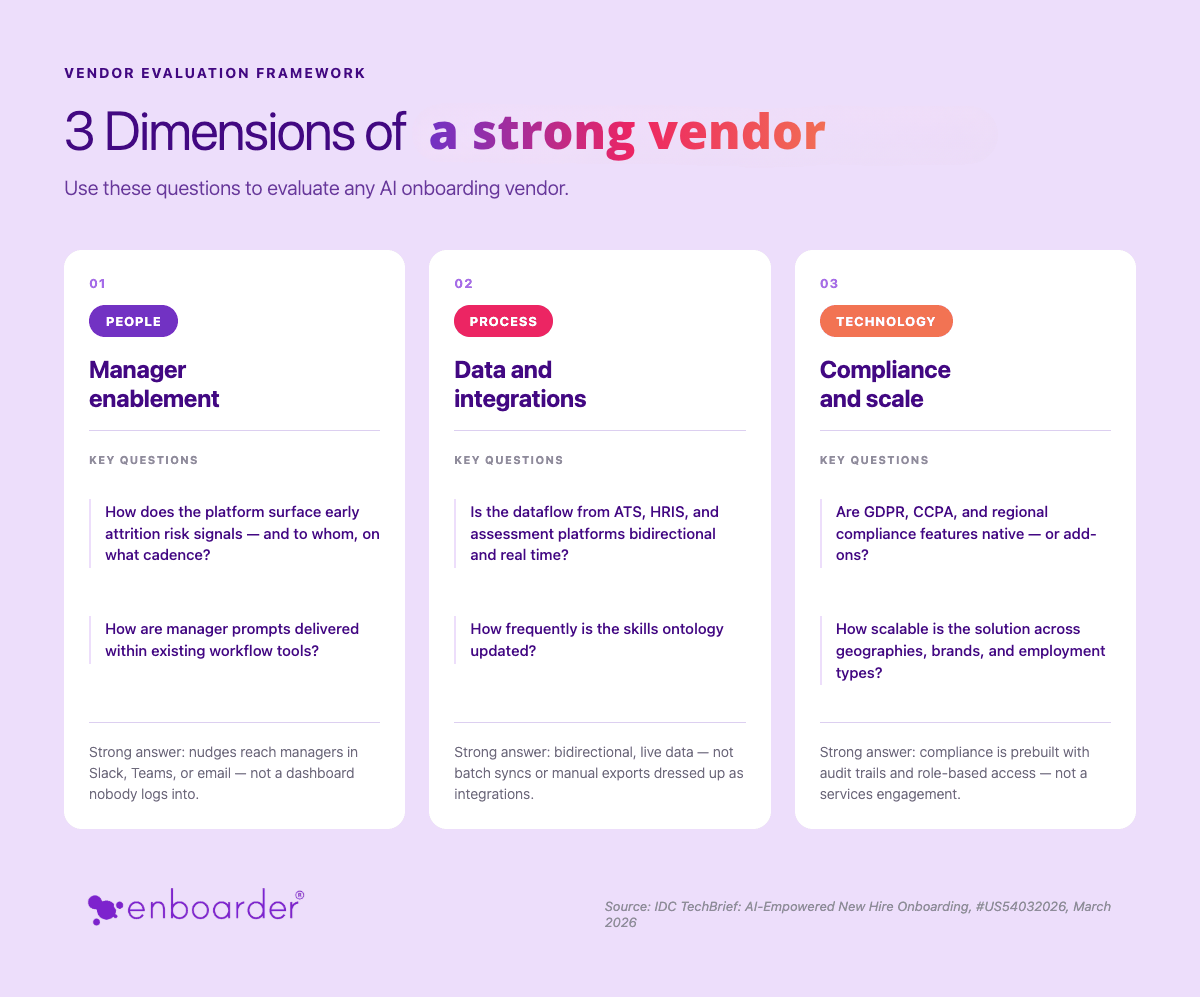
IDC’s research is clear: the three dimensions that determine whether an AI onboarding investment delivers lasting value are people (manager adoption), process (content governance), and technology (data integration). If you want a deeper look at how those dimensions play out inside your organisation before you start evaluating vendors, our AI onboarding readiness framework breaks it down.
The vendor evaluation questions below map directly onto those three dimensions. Group them that way as you score your shortlist.
Outcomes and ROI
1. What specific business outcomes will this solution address, how will success be measured, and what is the expected timeline?
This is the first filter. Any vendor worth evaluating should be able to answer this without hesitation — with specifics, not generalities. Push past “improved new hire experience” and ask for time-to-productivity benchmarks, retention impact, and administrative time savings from comparable customers.
The business case for AI onboarding is real and measurable. Enboarder customers have achieved a 20% increase in new hire productivity, reduced 90-day attrition by 36% (generating $1.68M in cost savings), and saved $3.7M per year by automating complex onboarding workflows. Those aren’t aspirational figures — they’re outcomes you should be able to reasonably expect if you deploy well.
2. How does the vendor define and track time to productivity?
“Time to productivity” means something different to every vendor. Some measure login completions. Others track 30/60/90-day milestone attainment. Fewer actually connect onboarding activity data to downstream performance outcomes. Know how your vendor defines it — and whether their definition aligns with how your business measures it.
Data and integrations
3. How does the solution ingest and integrate data from ATS, candidate assessment platforms, and HRIS? Is the dataflow bidirectional and real time?
This is non-negotiable. IDC’s research identifies lack of data integration across the HR tech stack as one of the top three reasons for poor talent acquisition outcomes. One-way data pushes, batch syncs, and manual exports are not integrations — they’re workarounds. Your platform needs to sit above your existing ATS and HRIS stack and pull bidirectional, real-time data to power personalised journeys.
Enboarder operates as an orchestration layer above your existing systems, transforming static data from your HRIS, ATS, LMS, and IT tools into coordinated, adaptive journeys in the flow of work. No rip-and-replace required.
4. What methodology is used to generate personalised skill profiles and learning plans? What is the underlying skills ontology, and how frequently is it updated?
AI-generated onboarding plans are only as good as the inputs behind them. A skills ontology that hasn’t been updated in 18 months produces plans that drift from reality fast. Ask vendors to show you the methodology and the update cadence — not just the output.
Workforce complexity and adaptability
5. How does the solution adapt to different work models (remote, hybrid, in-person) and employee types (salaried, hourly, contingent, international)?
Enterprise onboarding is never one-size-fits-all. Your workforce spans multiple regions, roles, employment types, and time zones. A platform that can only deliver a consistent experience for full-time desk workers in one geography isn’t built for enterprise scale.
Enboarder’s journeys adapt by role, location, function, and behaviour — ensuring every new hire receives an experience that’s relevant to their context, not a generic checklist in a different language.
People: manager enablement
6. What engagement monitoring capabilities are built in? How does the platform surface early attrition risk signals, and to whom are they delivered, and on what cadence?
Manager adoption is the single biggest variable in any AI onboarding rollout. But managers can only act on signals they can see. Ask vendors how their platform surfaces engagement data, flags early attrition risk, and delivers that intelligence to the right person at the right time — not buried in a dashboard nobody checks.
7. How are manager conversation guides and coaching prompts generated and delivered within existing manager workflow tools?
The answer to this question reveals whether a vendor understands how managers actually work. Conversation guides that live in a separate platform nobody logs into are useless. Prompts need to reach managers in Slack, Teams, or email — where their attention already is. Enboarder delivers manager nudges, coaching prompts, and structured check-ins directly into the flow of work, making adoption effortless rather than optional.
Compliance and data privacy
8. What regional compliance, data privacy, and data residency features are available? How does the solution handle GDPR, CCPA, and equivalent regional requirements?
AI onboarding platforms ingest sensitive compensation, skills, and performance data at scale. That data crosses HR, IT, and compliance systems — expanding the attack surface significantly. Audit trails, role-based access controls, and regional compliance features need to be native and pre-built into the platform. If a vendor positions these as add-ons or professional services engagements, that’s a red flag.
Our AI onboarding readiness checklist covers the internal governance questions you should answer before you get to this stage of vendor evaluation.
AI transparency and risk
9. What transparency and explainability mechanisms exist for AI-generated recommendations?
When AI generates a personalised 30/60/90-day plan, a buddy match, or a learning path, new hires and managers should be able to understand the reasoning behind it. “The AI decided” is not good enough — especially in regulated industries or regions with AI explainability requirements. Ask vendors to show you how recommendations are surfaced and explained.
10. How does the vendor manage ongoing model updates, and how are organisations notified of changes to underlying algorithms that could affect onboarding outputs?
AI models change. When they do, onboarding experiences can shift in ways that aren’t immediately visible to HR administrators. Strong vendors have a clear governance process for model updates, proactive communication protocols, and mechanisms for customers to review and approve changes before they affect live journeys.
Implementation and scale
11. What implementation timeline, resource requirements, and change management support does the vendor provide?
A platform that takes nine months to implement and requires a dedicated IT project team is not designed for agility. Ask for a realistic implementation timeline, the internal resource commitment required, and what change management support the vendor provides — particularly for manager adoption. This is where promising deployments stall.
12. How scalable is the solution across multiple geographies, brands, and employee populations with differing onboarding requirements?
Your onboarding needs today are not your onboarding needs in three years. A solution that works beautifully for one business unit but can’t scale across a global enterprise with multiple brands, languages, and hiring profiles isn’t a strategic investment — it’s a pilot that will need to be replaced.

Use this list as a discovery tool, not just a checklist
These questions work in two directions. Put them to vendors during evaluation. But run them internally first — your answers will sharpen your requirements and help you build a tighter business case with your exec stakeholders.
For the internal readiness questions that pair with this vendor framework, download our AI onboarding readiness infographic — it covers the people, process, and technology dimensions your organisation needs to assess before you invest.
And if you want the full picture of how IDC’s research shapes the AI onboarding market, download the complete IDC TechBrief: AI-Empowered New Hire Onboarding. It’s the most substantive independent analysis of this market available right now — and it’s free.
