

Retail onboarding is the process of preparing a new store hire, from accepted offer to independent floor work, so they know the systems, the products, and the people around them before their first solo shift. Done well, it’s the difference between a hire who’s selling with confidence in week one and one who quits before their second paycheck.
Hourly, in-store roles turn over at close to 76% a year, according to U.S. Bureau of Labor Statistics data analyzed by DailyPay. McKinsey found nearly half of frontline retail employees were already weighing whether to quit. Enboarder’s own State of Frontline and Volume Hiring 2026 research names candidate drop-off, people who accept an offer and never show up, as the single biggest threat to frontline hiring right now.
Hiring faster doesn’t fix any of that. Onboarding better does. This guide walks through that process step by step, gives you a checklist you can adapt store by store, and shows you where a template earns its keep versus where it breaks down once you’re running fifty stores instead of one.
Why Retail Onboarding Is Worth Fixing
A retail new hire has usually met their manager once, filled out paperwork twice, and heard almost nothing from the company between accepting the offer and showing up for shift one. That silence is where drop-off happens. Candidates take other offers, forget the start date, or lose the thread of why they said yes in the first place.
The fix takes intent, not complexity. Structured onboarding, the kind that starts before day one and keeps building through the first 90 days, gives new hires a reason to show up and a reason to stay.
Hugo Boss, a global fashion retailer with more than 1,000 stores, proved this at scale by replacing ad hoc manager outreach with a consistent, mobile-delivered journey.
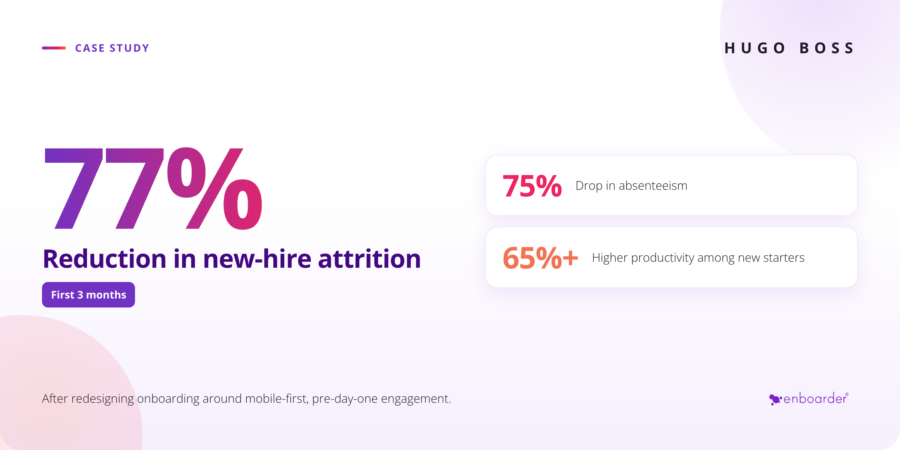
77% reduction in new-hire attrition, plus a 75% drop in absenteeism and 65%+ higher productivity among new starters, in the first three months after Hugo Boss redesigned onboarding around mobile-first, pre-day-one engagement.
Read the full case study.
That’s a structured process changing an outcome, not a good intention sitting in a manager’s inbox.
The cost of getting this wrong compounds fast. A store manager who loses a new hire in week two doesn’t just lose that person’s wages and training time. They lose the shifts that person was covering, the customers who noticed a stranger behind the register every few weeks, and the credibility of the “we’ll train you properly” line the next candidate hears in their interview. Fix onboarding once, at the process level, and every one of those costs drops together.
What Makes Onboarding Different in Retail
Retail onboarding means preparing hourly, shift-based staff, across dozens or hundreds of locations, to work a register or a floor safely and confidently, usually within days of accepting an offer. It looks nothing like onboarding a salaried office hire.
Five things set it apart:
- Shift-based hours. Training has to fit around rosters, not a single orientation day.
- Multi-location consistency. A process built for one store needs to hold up identically in fifty.
- Seasonal surges. Waves of hires need to be productive in days, not weeks.
- A split skill set. Floor skills and POS systems both need hands-on practice, not a slide deck.
- No company email. Most new retail hires don’t have one on day one, so anything you send has to reach a personal phone instead of an inbox.
Add the compliance layer, minor-labor rules and safety requirements that a white-collar onboarding template never has to touch, and the gap between “office onboarding” and “retail onboarding” widens further. Retail onboarding shares roots with the broader challenge of onboarding frontline and deskless workers, but the store floor adds its own pressure: customers are watching from minute one, and a slow ramp shows up directly in service and sales.
The Retail Onboarding Process, Step by Step (Offer → Floor-Ready)
Most onboarding frameworks describe five stages: preboarding, orientation, training, integration, and ongoing evaluation. For a retail floor, those five collapse naturally into four practical phases.
| Phase | Timing | What Happens |
|---|---|---|
| Preboarding | Offer accepted → Day 1 | Comms, paperwork, uniform and schedule logistics |
| Day One | First shift | Store tour, systems access, manager and buddy connection |
| Week One | Days 2-7 | Shadowing, product knowledge, first supported sale |
| 30-60-90 | Weeks 2-13 | Supervised → independent → full ownership |

Before Day One: Preboarding and Paperwork
The gap between “yes” and “day one” is where most retail no-shows happen, and it’s entirely preventable. Send offer confirmation, start date, dress code, and parking or transit details by SMS within 24 hours of acceptance, not buried in an email nobody opens. Get uniform sizing, schedule confirmation, and any minor-labor or safety paperwork done before the hire ever walks in, so day one is about the job instead of forms.
90% engagement rate on preboarding communications sent between offer and start date, T-Mobile. See how its preboarding program closed the offer-to-day-one gap at scale.
Day One: Store Tour, Systems, and First Connections
Day one should build connection before it builds competence. Have the manager greet the new hire personally rather than routing them straight to a training module. Assign a buddy, an experienced peer who can answer the questions a new hire won’t ask their manager. Walk the store, cover safety basics, and get POS logins working before the first customer interaction, not during it.
Week One: Shadowing, Product Knowledge, and First Sales
Training that should be included for internal retail teams in the first week is short, repeated, and on the floor, not a single long session up front. Break product knowledge into short bursts a new hire can absorb between customers rather than one overwhelming morning of information. Pair every new hire with their buddy for early customer interactions so they have backup nearby the first time something goes wrong. Let the first sale happen with support in the room, not alone.
30-60-90: From Supervised to Solo to Standout
The 30-60-90 rule splits the first three months into three phases with distinct goals: the first 30 days for learning the role and systems under supervision, days 31 to 60 for working more independently while still checking in regularly, and days 61 to 90 for operating solo and starting to stand out. For a retail hire, that maps to supervised shifts, then solo shifts with manager check-ins, then full ownership of a section or shift. Our 30-60-90 day plan guide breaks down milestones by role if you want the fuller framework.
Retail Onboarding Checklist
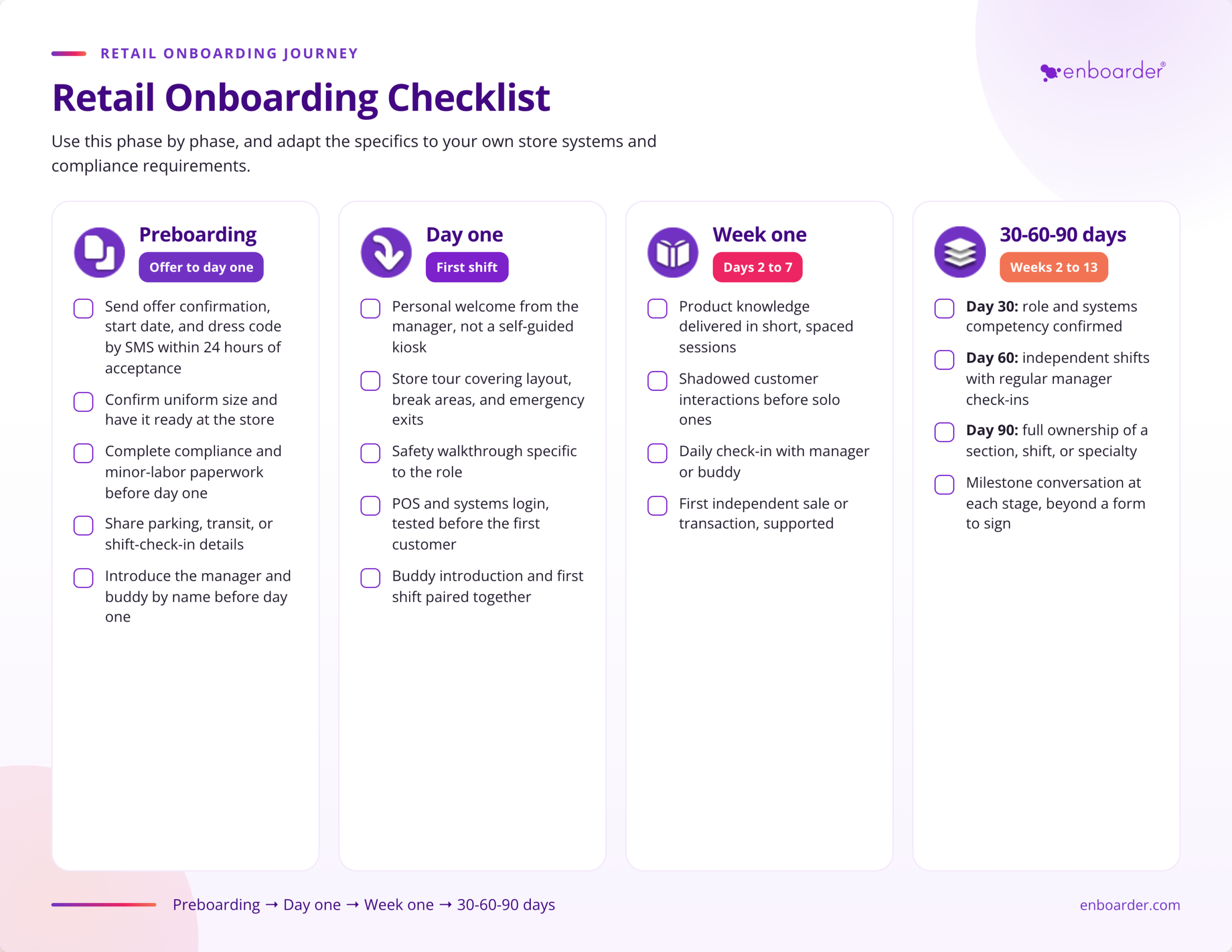
Use this phase by phase, and adapt the specifics to your own store systems and compliance requirements.
Preboarding (offer to day one)
- Send offer confirmation, start date, and dress code by SMS within 24 hours of acceptance
- Confirm uniform size and have it ready at the store
- Complete compliance and minor-labor paperwork before day one
- Share parking, transit, or shift-check-in details
- Introduce the manager and buddy by name before day one
Day one
- Personal welcome from the manager, not a self-guided kiosk
- Store tour covering layout, break areas, and emergency exits
- Safety walkthrough specific to the role
- POS and systems login, tested before the first customer
- Buddy introduction and first shift paired together
Week one
- Product knowledge delivered in short, spaced sessions
- Shadowed customer interactions before solo ones
- Daily check-in with manager or buddy
- First independent sale or transaction, supported
30-60-90 days
- Day 30: role and systems competency confirmed
- Day 60: independent shifts with regular manager check-ins
- Day 90: full ownership of a section, shift, or specialty
- Milestone conversation at each stage, beyond a form to sign
Retail Onboarding Checklist
Get the retail onboarding checklist as a printable one-pager.
Onboarding Seasonal Retail Hires (Without Cutting Corners)
Seasonal hiring compresses this entire process into days instead of weeks, and it’s tempting to cut what feels optional. Don’t cut compliance, safety, or the first personal connection. Those three protect the new hire and the business, and skipping them is how seasonal turnover gets worse, not better.
Compress the parts that can flex instead: spread product knowledge over fewer, denser sessions instead of a full week of shadowing, lean harder on the buddy system since there’s less time for manager check-ins, and automate the preboarding communications so a hiring surge doesn’t overwhelm a store manager’s inbox. Our guide to seasonal employment covers how to treat seasonal hires as a genuine talent pipeline rather than a one-off cost.
How to Measure Retail Onboarding Success
Four numbers tell you whether onboarding is working. Time to floor-readiness counts the days between a start date and the point a hire works a shift independently and safely. 90-day retention keeps the first number honest, a fast ramp that doesn’t stick moves the churn a few weeks later instead of removing it. First-shift no-show rate flags a preboarding gap before day one even arrives. Mystery-shop or early CSAT scores, where available, show whether floor-readiness reaches the customer.
If you’re trying to reduce the time it takes new retail hires to reach full productivity, watch shifts to independence rather than hours trained, how many shifts pass before a manager stops actively supervising and starts spot-checking instead. Our guides on time to productivity and reducing ramp-up time go deeper on how to benchmark and improve both.
Set a baseline before you change anything. Pull your last two quarters of new-hire data, average the four numbers above, and use that as the target you’re trying to beat. Without a baseline, “onboarding got better” is a feeling, not a result you can report to a district manager or a CFO.
Retail Onboarding: Frequently Asked Questions
What is retail onboarding? The process of preparing a new store hire, from accepted offer to independent floor work, covering systems, product knowledge, compliance, and connection to their manager and team.
What are the 5 stages of the onboarding process? Preboarding, orientation, training, integration, and ongoing evaluation. On a retail floor, those collapse into four working phases: before day one, day one, week one, and the 30-60-90 stretch.
What is the 30-60-90 onboarding rule? A framework that splits the first 90 days into three phases: days 1-30 for learning the role under supervision, days 31-60 for working more independently, and days 61-90 for full solo ownership.
How long should it take a new retail hire to reach floor-readiness? There’s no universal number, it depends on role complexity and store volume, but the metric to track is shifts to independence, not calendar days. A consistent preboarding and week-one process is what shortens it.
How do you onboard seasonal retail hires without cutting corners? Compress what can flex, product knowledge sessions, shadowing time, but never cut compliance, safety, or the new hire’s first personal connection to a manager or buddy.
Deliver Consistent Retail Onboarding Across Every Store with Enboarder
A checklist and a template solve onboarding for one store. Consistency across fifty stores, or five hundred, needs something that runs itself. Enboarder automates the preboarding-to-floor-ready journey over SMS, so every new hire gets the same experience whether their store manager is having their best week or their worst. Managers get nudges instead of another task to remember, and HR gets visibility into where hires are stuck without chasing every location individually.
Hugo Boss ran exactly this model across its store network and cut early attrition by 77%. That’s what consistent retail employee onboarding looks like when a process replaces guesswork store by store.
If you’re ready to see it for your own footprint, explore Enboarder’s frontline onboarding solution or book a demo to walk through it live.
