

Frontline teams don’t onboard the way office teams do, and treating them the same way is the fastest way to lose a new hire before their first real shift. If you’re working out how to onboard frontline employees who work rotating shifts, split across multiple sites, and rarely check a work email, the process needs to look different from a desk-based new hire journey. Here’s what to change, and why it works.
Why Frontline Onboarding Needs a Different Playbook
Frontline and deskless employees make up the majority of the global workforce, but most onboarding software and process design still assumes everyone sits at a desk with a laptop and a company inbox. That mismatch shows up fast:
- Frontline hires are distributed across sites, so onboarding leans on local managers to actually run it, not a central HR team.
- Shifts are rotating, night, weekend, or part-time, so a single fixed onboarding schedule rarely fits.
- Most frontline workers don’t have a corporate email account, and many can only be reached through a personal phone or a company device they take home.
- The job often carries a real safety, licensing, or certification requirement before someone can start unsupervised work, on top of the usual paperwork.
- Turnover in frontline-heavy industries like manufacturing, transport and logistics, construction, and field service regularly runs from 40% to well over 100% a year.
None of that means frontline onboarding is harder to solve. It means it needs its own design, not a smaller version of the knowledge-worker process.

The Cost of Getting It Wrong
Frontline onboarding failures are expensive in ways that are easy to underestimate, and the damage often starts before onboarding even begins: slow hiring decisions cost frontline employers candidates who simply take another offer. Every open shift that goes uncovered, every new hire who quits before they’re fully trained, and every certification that lapses without anyone noticing adds up in lost productivity, overtime coverage, and re-recruiting cost. Industry estimates put the cost of replacing a single frontline worker well into the thousands of dollars once training time and slow time-to-productivity are factored in.
Most of that cost is preventable. It comes from onboarding that runs on spreadsheets, paper forms, and manual handoffs between HR, the site manager, and whoever is training the new hire that week. Fix the process, and the cost curve moves with it.
How to Onboard Frontline Employees: A Step-by-Step Process
1. Start before Day 1, not on it
The biggest opportunity in frontline onboarding sits before the new hire ever shows up. A meaningful share of frontline candidates disengage or don’t show up at all before their first shift, which makes the gap between offer and start date just as important as the shift itself. Use that time to get logistics, forms, and basic orientation out of the way, so Day 1 is spent on the job, not on paperwork. A strong preboarding process means a new hire arrives already knowing where to park, what to wear, who their manager is, and what their first shift looks like. And Day 1 itself isn’t the finish line: the clearest signal on whether onboarding is working often shows up a week later, not on the first shift.
2. Build a role-specific readiness plan, not a generic checklist
A forklift operator, a home care worker, and a retail associate don’t need the same onboarding. Build a readiness plan around what each role actually requires: the equipment they’ll use, the certifications they need, the people they’ll report to, and the milestones that mark real readiness. A generic 30-day checklist misses all of that; think of it instead as a roadmap built around the role, not a one-size-fits-all list, and it gets a new hire safe and productive in hours, not weeks.
3. Meet workers on the device already in their pocket
Don’t ask frontline employees to log into a portal on a desktop they don’t have. Deliver onboarding through personal phones or company-issued devices, in the language they’re most comfortable with. Multilingual onboarding matters most here: workforces with a meaningful share of multilingual employees show measurably longer tenure when onboarding meets them in their own language instead of defaulting to English-only content.
4. Orchestrate the safety and certification gate, don’t try to be it
Most frontline roles have a real gate to clear before someone works unsupervised: a safety certification, a licence, a screening requirement, or a training sign-off, depending on the industry and the market. The right approach is to orchestrate the path to that gate, tracking who’s cleared, who’s pending, and what’s overdue, rather than trying to act as the certifying authority yourself. That distinction matters both for compliance and for keeping the process honest. Compliance gaps are easy to miss in a distributed, deskless workforce, which is exactly why they need to be tracked systematically instead of assumed.
5. Reinforce skills after Day 1 with practice, not just paperwork
Onboarding doesn’t end when the forms are signed. New hires retain more when they get to apply what they’ve learned: answering scenario-based questions, practicing a real workflow, and reflecting on what they’ve absorbed. Short, guided practice after Day 1 closes the gap between “trained” and “actually ready,” and it’s far cheaper than learning through an on-the-job mistake.
6. Give managers visibility without adding to their workload
Site and shift managers are often the ones actually running onboarding day to day, and they’re usually doing it on top of a full operational job. Give them a simple view of who’s on track, who’s stalled, and where to step in, instead of one more manual workflow to update on top of everything else on their plate. Managers who can see onboarding status in one place catch problems early instead of finding out a new hire quit three weeks in.
What Good Frontline Onboarding Looks Like in Practice
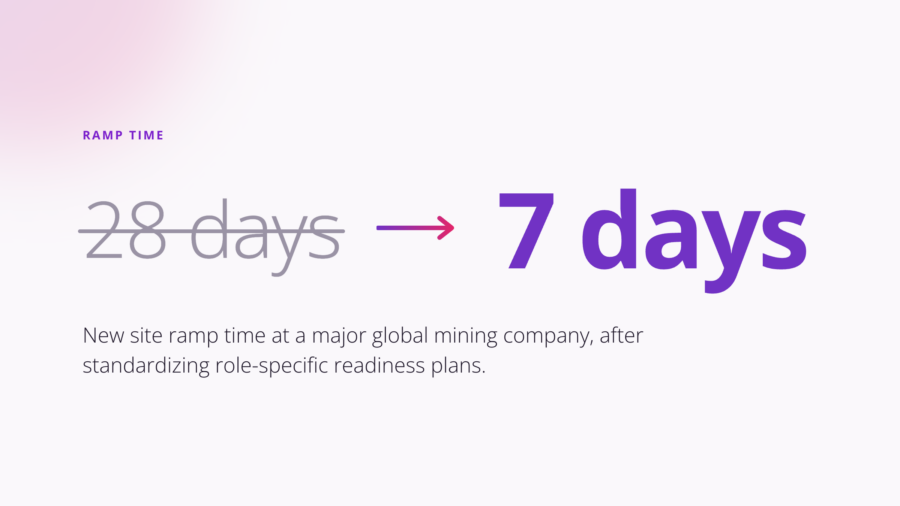
Employers who redesign onboarding around these steps see the difference in the numbers. One large healthcare organization cut new hire attrition by 36% after replacing manual, paper-based onboarding with a structured, digital process. A major global mining company brought new site ramp time down from 28 days to 7 after standardizing role-specific readiness plans across locations. And organizations using a connected, orchestrated approach to new hire onboarding have seen up to a 20% lift in new hire productivity compared to ad hoc, manual processes.
None of these results come from a single tool or a single tweak. They come from treating frontline onboarding as its own process, designed around shift work, distributed sites, personal devices, and the certification gates that come with the job. If turnover is the metric leadership cares about most, pair this process with a dedicated attrition reduction strategy rather than treating onboarding as the whole fix.
Frontline Onboarding Checklist
- Start onboarding before Day 1, not on it.
- Build readiness plans by role, not one generic checklist for everyone.
- Deliver onboarding to the device workers already carry, in their own language.
- Track the path to every safety or certification gate without acting as the certifying body.
- Reinforce training after Day 1 with practice, not just a signed form.
- Give managers one clear view of onboarding status across their team.

Getting frontline onboarding right takes more than good intentions from a busy site manager. It takes a process built for shift-based, deskless teams from the ground up, not a knowledge-worker workflow stretched to fit. That’s the gap Enboarder’s frontline onboarding platform is built to close: see how it works on the Employee Onboarding Automation page, or book a demo to walk through it for your own frontline teams.
Related reading: Best Onboarding Practices, Automation vs. Human Judgment in Frontline Hiring
