

Frontline and deskless workers now make up most of the modern workforce, and most of them never touch a company laptop, a corporate inbox, or an office chair. They accept an offer, wait, and either show up or don’t for a first shift that decides whether they stay for a year or a week. Get onboarding right in that window and a plant, store, or site fills with people who show up trained and ready to work. Get it wrong and the same req is back on the job board by Friday.
This guide walks through eight steps for onboarding frontline and deskless employees, built on data from the State of Frontline & Volume Hiring 2026 report. It applies whether you’re hiring store associates for a retail chain, line workers at a manufacturing plant, drivers and warehouse staff in logistics, care staff in healthcare, or seasonal crews in hospitality and food service. Use it to design a program that starts the moment a candidate accepts an offer and carries through the first weeks on the floor, not one that starts and ends on Day 1.
Why Frontline Onboarding Is Different
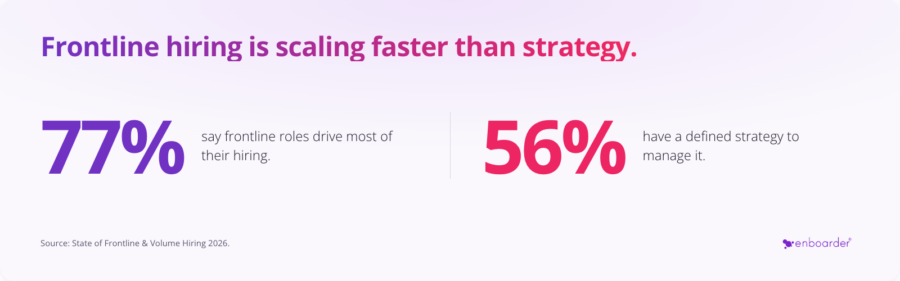
Frontline and hourly roles now drive most hiring volume at the average organization. 77% of high-volume employers say frontline or hourly roles account for most of their hiring this year, and 51% describe themselves as active high-volume hirers. Only 56% of them have a defined strategy for managing it. That gap between scale and structure is where onboarding programs break.
Retail associates, plant operators, delivery drivers, and care staff don’t check a company inbox between an accepted offer and a first shift. Many work across dozens of sites and shift patterns, reporting to a site manager who’s onboarding a new hire every week instead of once a quarter, often in an industry with heavy safety, certification, or regulatory requirements layered on top of the hiring rush. A platform built for the frontline has to meet workers where they are: on a personal phone, between shifts, without a login. That’s a different design problem than onboarding a desk-based new hire, and copying the white-collar playbook onto a frontline workforce is one of the fastest ways to lose a new hire before they start.
A high-volume distribution center hiring 40 warehouse associates a week and a regional healthcare provider hiring a handful of clinical technicians a month face the same underlying problem: an onboarding process designed for salaried, desk-based employees doesn’t hold up once shift schedules, distributed sites, and hourly pay enter the picture.
The Real Enemy: No-Shows and Early Attrition
The biggest risk to a frontline hire isn’t a rough first day. It’s never showing up at all.
61% of high-volume employers report interview and first-shift no-shows as a top hiring challenge, and 43% report candidates who accept an offer and then go quiet before Day 1. Every day between an accepted offer and a first shift is a day a candidate can change their mind, take a competing offer, or stop responding altogether. Frontline hiring’s reliability crisis starts here, long before a new hire ever clocks in for a shift.
Early turnover follows the same pattern. High early attrition and inconsistent hiring manager coordination both rank among the top operational headaches frontline leaders report in the same research. A distribution center that loses a quarter of its new hires in the first month isn’t dealing with a training problem. It’s dealing with an onboarding system that never engaged them in the first place, and recruiting keeps filling a bucket with a hole in the bottom.
Treat onboarding as a conversion system that starts the moment a candidate accepts an offer, not a checklist that starts on Day 1, and both problems get easier to solve. The eight steps below build that system in order, from the offer through the first ninety days.
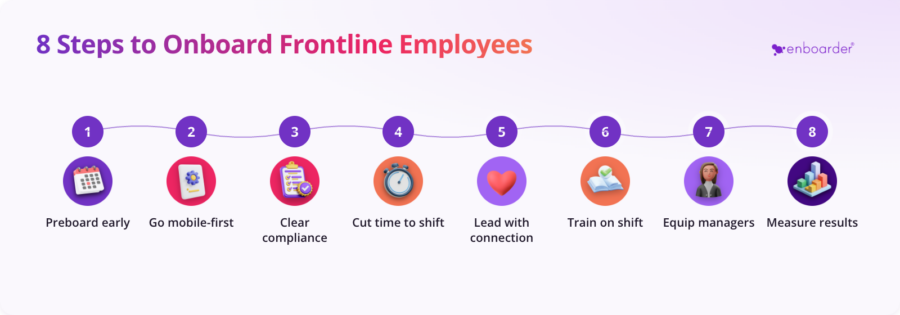
How to Onboard Frontline and Deskless Employees in 8 Steps
Here are eight steps that move a new hire from accepted offer to productive team member. Each includes what to do, why it works, and a quick example of what it looks like in practice.
1. Start at Yes: Preboard Before Day One
The gap between an accepted offer and a first shift is where most no-shows happen, and it’s the easiest gap to close. Build a structured preboarding journey: a welcome message the day a candidate signs the offer, a short countdown of what to expect each week, and a reminder the night before the first shift. T-Mobile built this kind of preboarding journey and reached a 90% engagement rate on its preboarding communications, turning an idle two-week wait into an active one.

Picture a retail chain hiring 150 seasonal associates ahead of a holiday peak. Instead of one offer letter and silence until the first shift, each new hire gets a short text every few days: what to wear, who to ask for, what the first hour looks like. By the time they walk in, the job already feels familiar, and the manager on shift already has a name and a face to expect instead of a stranger on a schedule.
2. Go Mobile-First (Meet Workers on Their Phones)
Frontline workers don’t have a corporate email address or a company laptop, and most won’t download an app just to see their own onboarding journey. Build the entire preboarding and onboarding experience for a phone browser: SMS-first messaging, QR codes for document access, and no-login links that open straight into the content a new hire needs. If a step requires a password, an app store visit, or a desktop, assume most new hires will skip it.
A distribution center that texts a new hire their first-day parking instructions and a photo of their site manager will get more first-shift arrivals than one that emails a PDF employee handbook to an address the new hire checks once a month.
3. Get Compliance Done Before the First Shift
Paperwork on the floor slows down everyone around a new hire and turns their first impression of the job into a stack of forms. Move hiring paperwork into the preboarding window instead: I-9, E-Verify, W-4, and state withholding forms for U.S. hires, or the equivalent hiring documentation for your market, all signed, verified, and filed before the new hire’s first shift. This also closes the compliance gap that shows up in remote and deskless onboarding, where paperwork depended for years on someone being at a physical office to sign it. See how to structure this in our guide to preboarding and compliance.
If your roles carry safety certifications or license requirements on top of standard hiring paperwork, track those separately and confirm each one before the new hire steps onto the floor. A missing certification discovered on shift is a safety incident waiting to happen, not a paperwork delay to fix later.
4. Compress Time to First Shift
Speed is a retention lever, not just an efficiency metric. Every idle day between an accepted offer and a first shift raises the odds a candidate disengages, takes another offer, or simply stops answering the phone. Set a target time-to-first-shift measured in days, then build the preboarding journey backward from that date so every step has a deadline instead of drifting.
5. Make Day One About Connection, Not Paperwork
If steps one and three are done right, Day 1 doesn’t need to be a paperwork marathon. Use it for what builds retention: a manager greeting the new hire by name, a buddy introduction, a tour of the site, and a clear picture of what the first week looks like. A warehouse associate who meets their team and knows where to find a locker on Day 1 shows up more confident on Day 2 than one who spent the morning signing forms.
Assign the buddy before Day 1, not on it. A new hire who already knows Marcus is picking them up at the front desk at 8am feels expected. One who meets a random coworker mid-shift feels like an interruption to someone else’s day.
6. Train in the Flow of Work (Microlearning Over Manuals)
Frontline workers learn on shift, not in a training room working through a binder. Break training into short, role-specific modules a new hire can complete between tasks, and pair each one with a floor-readiness checklist a manager can confirm in seconds. A line worker who completes five-minute modules across their first three shifts retains more than one who sits through a two-hour orientation on day one and never sees the material again.
7. Equip Frontline Managers with Nudges and Checklists
Site and shift managers carry most of the onboarding load, whether or not the org chart reflects it. Gallup research puts a site manager’s share of the onboarding journey at 45-55%, and manager engagement accounts for roughly 70% of the variance in team engagement scores. Managers juggling a full shift rarely have time to read a training deck, so give them automated nudges, task checklists, and simple prompts delivered where they already work: on their phone, in the flow of their shift. A manager who knows exactly what to do on day one, day three, and day seven of a new hire’s tenure will outperform any onboarding manual.
8. Measure What Matters: Time to Productivity and 90-Day Retention
Track the metrics that predict whether onboarding is working: no-show rate, time to first shift, time to floor-readiness, and 30/60/90-day retention. A rising no-show rate or a stretching time-to-productivity number flags a breaking process weeks before an exit interview would. Set a baseline for each metric today, even a rough one, so next quarter’s number means something.
Compare these metrics site by site and shift by shift, not just company-wide. A single national retention number can hide a site with a specific manager or shift pattern driving most of the churn. Our guides on time to productivity and reducing ramp-up time go deeper on how to set and track these targets across a distributed frontline workforce.
How Enboarder Automates Frontline Onboarding at Scale
Running all eight steps by hand across dozens of sites and hundreds of hires a month isn’t realistic for most HR and TA teams, and it shouldn’t have to be. That’s the gap Enboarder’s frontline onboarding platform closes. SMS-first journeys replace email and self-service portals nobody visits. Compliance paperwork moves into the preboarding flow instead of piling up on Day 1. Managers get automated nudges and checklists on their phone instead of a task list buried in their inbox, and HR and TA leaders get a single view of every site’s no-show rate, time to floor-readiness, and 90-day retention instead of a spreadsheet stitched together once a quarter.
The results show up at scale. Eurest onboards 100 hires a month with a single program manager running the process end to end. T-Mobile reached a 90% engagement rate on preboarding communications across its frontline workforce. Neither result comes from a bigger team working longer hours. Both come from a journey that runs itself between offer and first shift, with a manager who’s supported instead of buried.
Want the full research behind these numbers? Read the State of Frontline & Volume Hiring 2026 report for the complete data set, or skim the State of Frontline & Volume Hiring 2026 infographic for a one-page version. If you’re comparing tools, see our roundup of the top AI onboarding platforms for large frontline workforces, and for the bigger picture on where AI fits into onboarding, read how AI is transforming new hire onboarding. Or book a demo to see how Enboarder builds this journey for your frontline workforce.
