

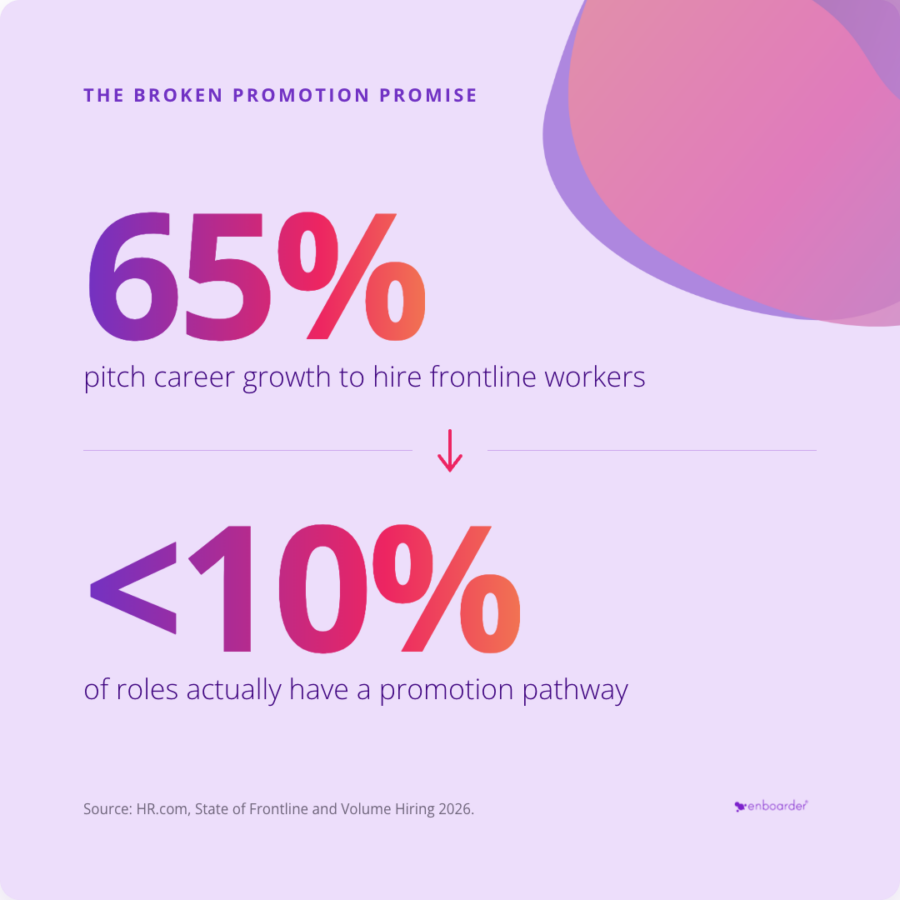
Career growth is the pitch every frontline employer makes. It shows up in the job ad, the interview, the offer call. And it works: the State of Frontline and Volume Hiring 2026 report, sponsored by Enboarder and conducted independently by HR.com’s HR Research Institute, found that 65% of employers now cite career growth opportunities as a top incentive for attracting frontline candidates, tied with referral bonuses for the number one spot.
That number lands at scale. Frontline and hourly roles make up 77% of all high-volume hiring today, which means this promise isn’t a niche recruiting tactic. It’s showing up in nearly every job ad, every interview, every offer conversation for the fastest-growing segment of the workforce. Recruiters are telling candidates: come here, and you’ll grow.
Here’s the problem. Most of them can’t back it up.
The Pitch Every Recruiter Makes
Put yourself in a frontline candidate’s shoes for a second. You’re weighing two or three offers, all with similar pay. The thing that tips the decision is often the story about what comes next: a path from associate to shift lead, from technician to supervisor, from driver to dispatcher. Employers know this, which is why career growth has become such a reliable line in the hiring pitch.
It makes sense as a strategy. Frontline workers increasingly behave like informed consumers of the labor market. They compare offers, read reviews, and talk to people already doing the job. A vague nod to “opportunities to grow” is an easy, low-cost way to differentiate an offer when the pay bands look nearly identical across competitors.
The trouble is that a pitch made at the interview table has to survive contact with the actual org chart. And for most frontline roles, it doesn’t.
The Reality Behind the Promise
Here’s the gap, in one line: 65% of employers pitch growth. Under 10% of roles actually have it mapped out.
In 42% of organizations, fewer than 10% of frontline roles have a defined promotion pathway within the first year. Not a vague sense that advancement is possible somewhere down the line. An actual, visible next step a new hire can see and work toward.
The State of Frontline and Volume Hiring 2026 report’s own authors put it plainly:
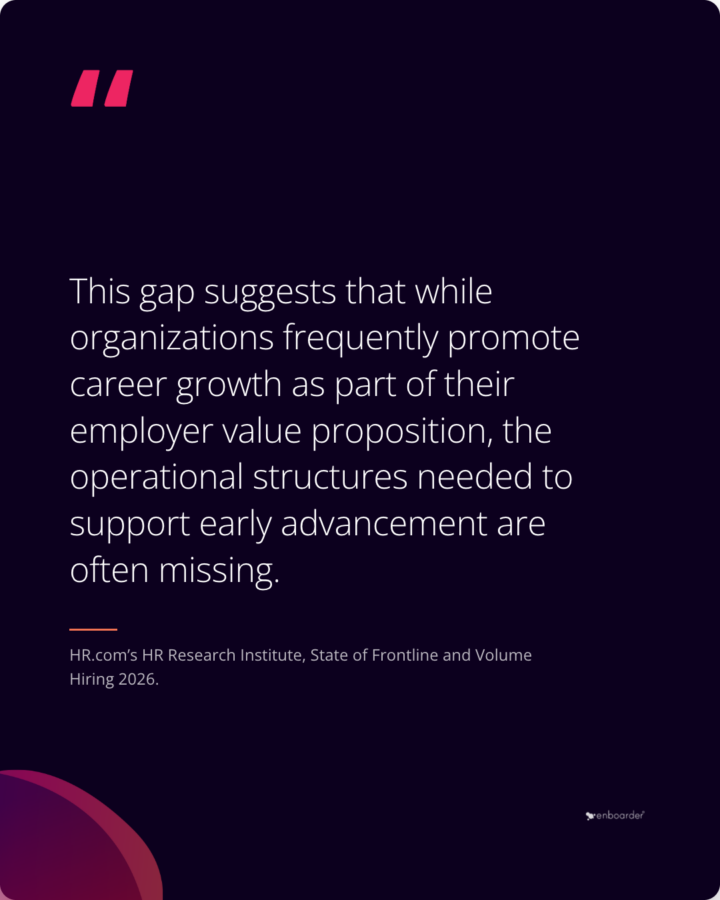
“This gap suggests that while organizations frequently promote career growth as part of their employer value proposition, the operational structures needed to support early advancement are often missing.”
Translation: the recruiting team is writing checks the operations team never agreed to cash. It’s not that leaders are lying to candidates on purpose. It’s that “career growth” gets treated as a marketing line during hiring and then quietly drops off the priority list the moment the new hire signs on. Nobody owns building the actual pathway, so it never gets built. For more on what a real internal mobility framework looks like once you get past the pitch, see our guide to internal mobility.
Why the Say-Do Gap Backfires
This isn’t just a broken promise. It’s a trust problem, and frontline workers notice faster than most employers expect.
Compensation still matters, but it’s not the whole story. 88% of workforce experts point to a combination of competitive hourly pay, career mobility, and predictable schedules as what drives whether frontline workers stay or leave. Pay gets people in the door. What happens after that, including whether the growth path they were promised actually shows up, determines whether they stick around.
That’s the piece employers miss when they treat the growth pitch as a recruiting tool instead of a retention commitment. A candidate who hears “there’s real room to grow here” during the interview and then spends a year with no visible path, no manager conversation about what’s next, and no clarity on how promotions actually happen isn’t just disappointed. They’re recalibrating how much they trust everything else the company told them, including the pay, the schedule, and the culture pitch.
Frontline workers talk to each other constantly, on the floor, in the break room, in group chats. When the growth story doesn’t match the lived experience, that mismatch spreads faster than any employer brand campaign can outrun it. A candidate who feels misled on career growth starts questioning the rest of the pitch too, including the schedule stability and the culture claims that seemed credible on day one.
Career mobility and predictable scheduling show up together in what experts say drives retention, and that pairing makes sense. Both are proof points a frontline worker uses to judge whether an employer’s promises hold up once the job actually starts. A schedule that shifts without warning sends the same signal as a promotion path that never appears: the thing you were told during hiring isn’t the thing you’re actually getting. Fix one without fixing the other and the trust gap barely moves.
If you want a sense of just how specific and pointed frontline candidates have gotten about probing this exact gap in interviews, our post on 50 candidate questions for internal promotion interviews is worth a look. Candidates are learning to ask the follow-up question recruiters used to be able to skip.
The Business Cost of an Empty Promise
Strip away the trust framing for a second and look at what this costs on a P&L.
When the growth story a candidate was sold doesn’t materialize, the most predictable response is that they leave. Turnover and churn are already a top recruiting challenge across the industry, and a 42%-of-orgs promotion pathway gap is a direct contributor to that number, not a coincidence sitting next to it. The organization ends up right back at square one: sourcing, screening, and onboarding a replacement for a role it just spent months and budget filling, often to make the same pitch to the next candidate.
Here’s what makes this harder to fix than it should be: only 27% of organizations say their recruiting metrics are even aligned with post-hire outcomes. Most companies can track cost-per-hire and time-to-fill without much trouble. Far fewer can tell you whether the people they hired last year, using the career-growth pitch, actually got the growth they were promised, or whether that unmet promise is quietly driving the churn showing up in the retention numbers.

And the timeline is often faster than most retention dashboards are built to catch. As we cover in It’s Not Day 1, It’s Day 7, the real crisis point for a lot of frontline hires isn’t the first-shift no-show. It’s the exit that happens once a new hire has had a week on the job to measure the recruiting pitch against the reality, including whether that “room to grow” conversation shows any sign of becoming real.
Re-hiring for the same role isn’t a rounding error. It’s recruiting spend, lost productivity during ramp-up, and a manager who has to onboard the same position twice in a year. All of it traces back to a promise made at the offer stage that nobody built the operational structure to keep.
Run the math on a single distribution center or retail region and the pattern compounds fast. Every frontline hire who leaves because the growth story didn’t hold is a seat the recruiting team fills again, at the same cost, with the same pitch, and often the same outcome. Without the metrics-to-outcomes link called out above, that cycle looks like ordinary turnover instead of what it actually is: a recruiting promise the business never operationalized, repeating itself quarter after quarter.
Closing the Gap: What Actually Works
The fix isn’t a bigger promise. It’s a smaller, more specific one that the organization can actually deliver on. The State of Frontline and Volume Hiring 2026 report’s own recommendations point to a few concrete moves, and they sit alongside the broader operational rework we cover in how to onboard frontline employees:
- Define what “promotion pathway” actually means for each frontline role. Even a simple, visible next step (associate to lead, technician to senior technician) beats a vague, open-ended promise about “growth opportunities.”
- Put the pathway in front of employees during onboarding and the first 90 days, not buried in a handbook nobody opens after week one. If the pathway only exists on paper, it doesn’t exist for the new hire.
- Make managers accountable for having the advancement conversation, not just the performance review. A once-a-year review checkbox isn’t the same as a manager who can name the next role and what it takes to get there.
- Check in at 30, 60, and 90 days. It’s the simplest of the four to start this quarter, and it keeps the promotion conversation from disappearing after the offer stage.
None of these require a new org chart or a compensation redesign. They require someone to own the follow-through on a promise that’s already being made in every job ad.
Make the Promise Real from Day One
The growth pitch isn’t the problem. Frontline workers want to hear it, and it’s a legitimate reason to choose one employer over another. The problem is that the promise gets made once, at the recruiting stage, and then has nowhere to live.
Connected onboarding closes that gap by turning the promise into something that actually shows up in a new hire’s day-to-day experience: the manager check-in that’s supposed to happen at 30 days actually gets triggered. The milestone conversation about what’s next gets scheduled instead of forgotten. The pathway a candidate heard about in the interview becomes something they can see and track, not something they have to ask about and hope someone remembers.
Want to see what that looks like in practice? Text yourself the Enboarder experience and walk through it as a new hire would. Or, if you’re further along and want to see how it connects the hiring pitch to the actual onboarding automation that keeps that promise on track, that’s the next place to look.
