
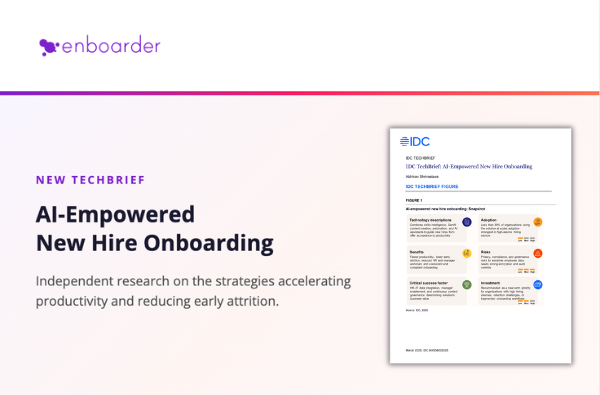
New independent research from IDC examines how AI is reshaping onboarding from a fragmented checklist into a personalized, outcome-driven experience. Here are the findings HR leaders need to see.
Onboarding has always been one of the highest-stakes moments in the employee lifecycle. It is where expectations are set, trust is built, and productivity either accelerates or stalls. Yet for most organizations, the reality still looks like this: generic welcome emails, delayed IT provisioning, disconnected compliance tasks, and managers left guessing about what to do and when.
The result? Slower ramp-up times, higher early attrition, and an experience that fails both the business and the people it is trying to retain.
A new IDC TechBrief, AI-Empowered New Hire Onboarding, examines how AI is fundamentally changing this picture. The research makes a compelling case that AI-powered onboarding is not a future-state aspiration. It is happening now, at scale, and the organizations that ignore it risk falling behind.
The Market Has Already Moved
One of the most striking findings in the IDC TechBrief is just how far adoption has come. According to IDC’s 2025 Global HCM Survey, 60% of organizations are already using or testing AI-empowered onboarding solutions, with another 25% planning to invest in the next 12 to 18 months.
That is not early-adopter territory. That is mainstream momentum.
As IDC Research Manager Abhinav Shrivastava put it: “AI-empowered onboarding solutions accelerate new hires’ time to productivity and help organizations improve employee retention. Organizations that ignore this shift toward AI-empowered onboarding risk falling behind in the race for talent and engagement.”
For HR leaders still running manual, fragmented processes, this data should serve as both a wake-up call and a roadmap. If you are just starting to explore what AI onboarding tools look like in practice, the pace of adoption makes one thing clear: the window to act is now.
Five Key Findings from the Research
The IDC TechBrief covers a lot of ground, from technology architecture to risk profiles. Here are the five findings we think matter most for enterprise HR and talent acquisition leaders.
1. Onboarding is a “critical inflection point” that most companies still get wrong
The IDC TechBrief describes candidate onboarding as “a critical inflection point between a signed offer and a productive, engaged employee.” Yet at most enterprises today, the process is broken into two disconnected halves: a compliance-heavy phase managed by recruiters, followed by a wildly inconsistent experience that varies team by team and manager by manager.
This is the gap AI is closing. Intelligent onboarding platforms unify these fragmented stages into a single, orchestrated journey that adapts by role, location, and individual context. The shift goes well beyond day one, transforming the entire arc from offer acceptance through the critical first year.
2. AI accelerates time to productivity in measurable ways
The report identifies accelerated time to productivity as a primary value driver. AI-enabled systems use skills and assessment data from recruitment to map new hire strengths, surface skill gaps relative to role requirements, and generate targeted development plans. Automated workflows handle access provisioning, equipment setup, and repetitive HR tasks so new hires and managers can focus on what matters: core responsibilities and relationship-building.
GenAI-enabled tools are now generating personalized 30/60/90-day plans based on job descriptions, resumes, and interview data. That is a massive shift from the static onboarding templates many companies still rely on. For a deeper look at how organizations are reducing ramp-up time in practice, the strategies align closely with what the IDC TechBrief describes here.
3. Personalized onboarding directly reduces early attrition
the IDC TechBrief highlights that personalized, context-aware, and high-touch onboarding experiences “minimize friction during the critical first 90 days when attrition risk is highest.” The report points to continuous sentiment monitoring as a key capability, enabling proactive intervention before issues escalate to resignations.
When new hires feel seen, supported, and connected from day one, they stay. The research validates what many HR leaders already know intuitively but struggle to operationalize at scale.
4. Manager enablement is a critical success factor
Technology alone will not fix onboarding. The IDC TechBrief emphasizes that, “Organizations relying on manual and fragmented onboarding processes not only face early-tenure attrition and longer ramp-up times but also underutilize assessment and skills data captured upstream in the talent acquisition life cycle. Successful deployment and value realization require a strong HR–IT partnership to facilitate data interchange across onboarding and adjacent systems. In addition, managers must be enabled to leverage these tools for guiding new hire conversations, setting expectations, and ensuring consistent messaging during the critical early days and months, the most important human touch point in the onboarding period.”
This is a crucial insight. AI-powered orchestration is not about removing the human element. It is about equipping managers with structured conversation guides, coaching prompts, and timely nudges so the human moments that matter most actually happen consistently.
5. Data integration is the foundation (and the biggest barrier)
The IDC TechBrief does not sugarcoat the challenges. According to IDC’s 2025 Global HCM Survey, lack of data integration across the HR tech stack is among the top 3 reasons for poor talent acquisition outcomes. Organizations evaluating AI onboarding solutions need to start with an honest assessment of their data foundation, including integrations, job description quality, skills taxonomies, and learning catalogs.
As the IDC TechBrief puts it: “As organizations explore AI-empowered new hire onboarding, they should begin by reviewing current onboarding responsibilities across HR, IT, managers, and learning teams, as well as assessing the efficiency of cross-functional workflows.
The next step is a thorough evaluation of the underlying data foundation, including integrations, job description quality, skills taxonomies, and learning catalogs, since weak inputs will constrain AI-augmented journeys and plans.” The technology is only as good as the data feeding it. This is one reason the best-of-breed approach to HR technology is gaining traction: purpose-built platforms that integrate deeply with existing systems tend to solve the data challenge more effectively than all-in-one suites.
What This Means for HR Leaders Right Now
The IDC TechBrief paints a clear picture: AI-empowered onboarding is accelerating across industries, with measurable gains in efficiency and retention. But success depends on three things working together: robust data integration, strong governance, and ongoing manager and HR engagement.
If you are evaluating your onboarding strategy, the report offers a practical framework. IDC outlines the questions organizations should ask internally and of vendors, covering everything from how time to productivity is defined and tracked, to how solutions adapt across remote, hybrid, and in-person work models, to what transparency mechanisms exist for AI-generated recommendations.
These are not theoretical questions. They are the operational details that separate organizations delivering real onboarding outcomes from those still stuck in spreadsheet-and-email mode. If you are ready to start building the business case for better onboarding technology, the IDC data gives you a strong foundation to bring to your leadership team.
Where Enboarder Fits
At Enboarder, we have been building toward this moment for years. Our Intelligent Journey Platform orchestrates the critical moments that matter across the employee lifecycle, from preboarding and onboarding to internal transitions and offboarding.
The capabilities IDC identifies as essential in this TechBrief, including workflow automation, personalized learning plans, manager enablement, sentiment monitoring, and bidirectional HR-IT data integration, are core to what Enboarder delivers today. We sit above existing HR, ATS, learning, and IT systems to transform static data and processes into coordinated action that drives productivity, improves retention, and reduces administrative burden.
The IDC TechBrief is independent research. We are sharing it because the findings align with what we see every day working with global enterprises: the organizations that orchestrate onboarding as a connected, intelligent journey consistently outperform those that treat it as a checklist.
Download the Full Report
The complete IDC TechBrief covers the technology landscape, adoption trends, risk profiles, metrics that matter, organizational readiness assessments, and the vendor questions you should be asking. Whether you are building the business case for AI onboarding or evaluating solutions, this is the research to ground your strategy in.
Download the IDC TechBrief Now
Source: IDC TechBrief, AI-Empowered New Hire Onboarding, Doc. #US54032026, March 2026. IDC conducted this research independently. The findings, analysis, and conclusions represent IDC’s objective assessment of the market. Enboarder did not participate in or influence the research methodology or findings.
