

The employee journey used to be a straight line: recruit, onboard, work, retire. Onboarding was a whirlwind of paperwork and compliance checks, while offboarding was little more than an exit interview and a final paycheck. That world no longer exists.
Today’s HR leaders are grappling with challenges like talent acquisition, adapting to AI, and employee well-being. Our 2025 HR Leader Survey of 1,000 HR decision-makers reveals a critical truth: traditional onboarding is broken, and it’s costing businesses dearly in time, money, and talent.
High attrition during the first 90 days is the number one challenge for 29% of HR leaders. The solution isn’t just about refining the first few weeks; it’s about fundamentally rethinking the entire employee lifecycle, powered by technology and a strategic focus on every stage, including the last one.
It’s time to move beyond paperwork and redefine the employee journey for a new era of work.
The True Cost of a Broken Onboarding System
The employee experience begins long before day one, during the recruitment process. But after the high engagement of receiving a job offer, many new hires are met with impersonal systems or, worse, radio silence. This disconnect is a major driver of early turnover. Our research shows 20.5% of organizations see up to half of their new hires leave within the first 90 days.
Furthermore, 60.8% of HR leaders report that this 90-day turnover has increased over the last year.
The financial impact is staggering. Most HR managers and directors estimate the cost of each failed new hire at up to $25,000, while C-suite executives place that figure closer to $50,000. This isn’t just a line item; it’s a direct hit to productivity, morale, and the bottom line.
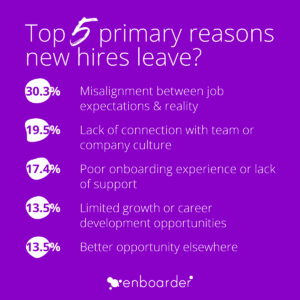
The primary reasons for early departures are clear:
- 30.3% cite a misalignment between job expectations and reality.
- 19.5% point to a lack of connection with the team or company culture.
- 17.4% blame a poor onboarding experience or lack of support.
These issues often stem from what we call the “Onboarding Black Hole”, a messy, inconsistent handoff between recruiting, HR, and hiring managers. Nearly half (49.4%) of HR leaders describe their handoff process as merely “adequate,” with occasional gaps, while 13.2% call it “inconsistent”. This lack of a structured process leaves new hires feeling disengaged and hiring managers unprepared. In fact, 83% of managers have received no formal training in people management, leaving new hire success up to chance.
The AI Shift: Automating Tasks to Accelerate Value
Modern HR teams know they need to modernize or be left behind. The administrative burden of manual onboarding is immense. Our survey found that 46.4% of HR leaders spend at least one week of admin time onboarding a single new employee. If you hire just 50 people a year, that’s nearly a full year spent on paperwork alone.
This is where AI is rewriting the rulebook. The shift is already happening, with nearly 80% of HR leaders reporting moderate to high reliance on AI in their HR processes. In the next 3-5 years, they expect AI to play a significant role in:
- Automating administrative tasks like paperwork and scheduling (61.9%).
- Providing personalized onboarding experiences (61.3%).
- Enhancing training and learning modules (60.6%).

AI-powered platforms can automate workflows, trigger communications, and deliver personalized content, freeing HR teams to focus on strategy rather than administration. For CHROs, the top priority for AI is creating these personalized experiences. By leveraging AI, organizations can move beyond a one-size-fits-all approach and connect new hires with the specific people, tools, and resources they need to succeed from day one.
This focus on personalization and efficiency directly addresses the biggest onboarding challenges. When asked what is most crucial for new hire success, 408 out of 1,000 HR leaders ranked “clear role expectations” as number one. AI can help deliver structured 30-60-90 day plans and systematically introduce new hires to subject matter experts, ensuring they have the clarity needed to become productive quickly.
Beyond Onboarding: The Strategic Imperative of Offboarding
The employee journey doesn’t conclude when an employee becomes fully productive; it extends to their very last day. Offboarding is often overlooked, but it represents another critical moment with a massive business impact. Our survey found that only 5.3% of HR leaders say offboarding is not a current focus area, signaling a major shift in priorities.
Why the sudden focus? Because inconsistent offboarding is costly. 41.6% of HR leaders say it costs their company up to $500,000 annually due to knowledge loss, security risks, and rehiring expenses. The top challenge, cited by 47% of respondents, is the loss of institutional knowledge. When an experienced employee leaves, they take years of expertise with them. A staggering 76.6% of organizations are very or somewhat concerned about this knowledge drain.
While 56.5% of companies claim to have a formalized process for capturing this knowledge, the high level of concern suggests these processes are either not being followed or are ineffective. This failure has a ripple effect, hitting the productivity and engagement of the remaining team members who have to pick up the slack. Other major offboarding challenges include:
- Loss of revenue or customer churn (41.2%).
- Non-standardized exit interviews (40.6%).
- Lack of deprovisioning for SaaS tools (40.5%).
A strategic offboarding process is not just about mitigating risk; it’s about turning departing employees into lifelong advocates and creating a smoother transition for the teams they leave behind. It ensures a complete transfer of knowledge, secures company assets, and provides valuable feedback that can be used to improve the overall employee experience.
Redefining the Journey to Win the First 90 Days—and Beyond
The data is clear: the old models of employee management are failing. To succeed in today’s competitive talent landscape, organizations must adopt a holistic view of the employee lifecycle, from the first touchpoint to the final farewell.
This means owning the entire journey. It starts with fixing the onboarding black hole by creating a seamless, cross-functional process that empowers hiring managers and gives new hires the clarity and support they need. Leveraging AI and automation is no longer a luxury but a necessity to deliver personalized experiences at scale and accelerate time-to-value.
And it culminates in treating offboarding with the same strategic importance as onboarding. By focusing on knowledge transfer and creating a positive final impression, you protect your business and strengthen your employer brand.
The companies that thrive will be those that move beyond outdated, disconnected technologies and manual processes. They will be the ones that use intelligent platforms to automate workflows, drive action, and build a more efficient and effective employee experience across every single stage. It’s time to redefine the journey.
